

What is Reciprocating Lift Conveyor?
A reciprocating lift conveyor, also called a vertical reciprocating conveyor (VRC), moves unit loads between fixed elevations on a guided carriage or platform. The carriage travels up and down between loading levels rather than circulating continuously through a closed vertical loop.
Reciprocating lifts are commonly used for cartons, totes, pallets, trays, containers, fixtures, and other unit loads that need controlled floor-to-floor or process-to-process transfer. Selection depends on the load, carriage size, vertical travel, number of levels, transfer arrangement, required throughput, and operating environment.
What Is a Reciprocating Lift Conveyor?
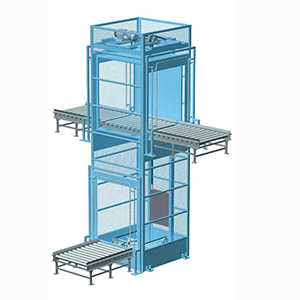
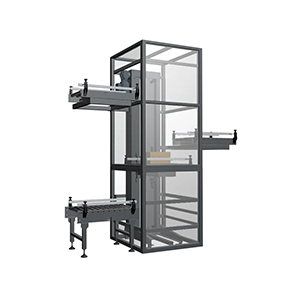
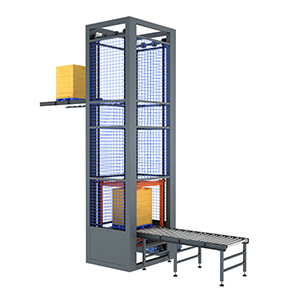
A reciprocating lift conveyor consists of a carriage or platform, guide structure, lifting drive, controls, safety devices, and the required infeed and outfeed interfaces.
The carriage supports the product throughout the vertical movement. Guide columns or a structural mast control its travel and keep the platform aligned with the loading and discharge levels.
VRCs may use mechanical or hydraulic actuation depending on the equipment design. Automatic systems can also integrate roller, chain, or other powered transfer equipment on the carriage so that products enter and leave without manual handling.
Unlike a continuous vertical conveyor, a reciprocating lift normally moves one carriage between levels. The carriage completes loading, vertical travel, positioning, unloading, and repositioning as part of each operating cycle.
For a detailed explanation of this sequence, see our vertical reciprocating conveyor working principle.
Typical CS Conveyor Reciprocating Lift Specifications
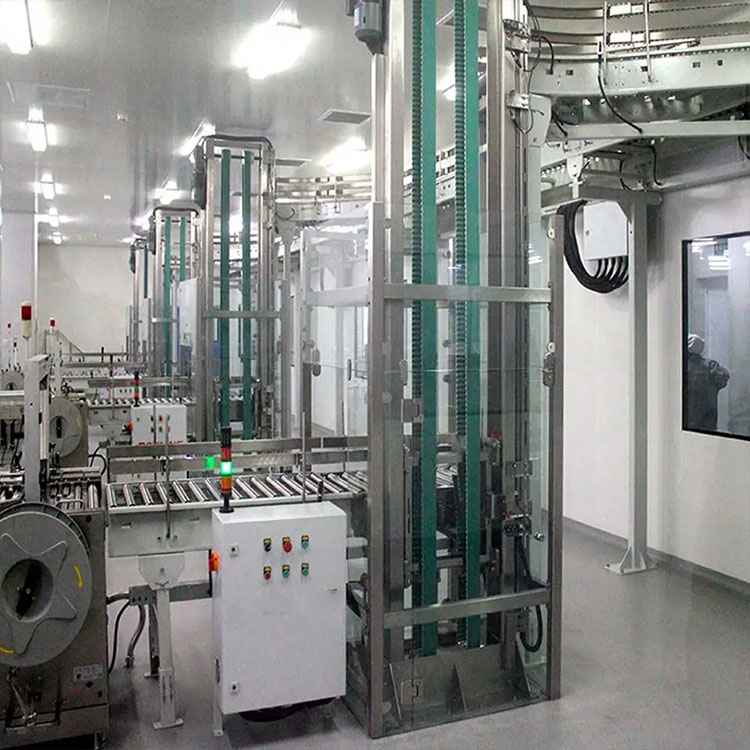
| Parameter | Configurable Range |
| Vertical travel | Up to 30 m |
| Travel speed | 0.25–1.5 m/s |
| Load capacity | Up to 5,000 kg |
| Operating temperature | -20°C to 60°C |
| Relative humidity | 0–80% RH |
| Power | Configured according to project |
These values describe the current configurable range of CS Conveyor reciprocating lift systems. Final specifications depend on carriage dimensions, load distribution, vertical travel, transfer arrangement, duty cycle, and project conditions.
The lift should also include the guarding, landing protection, travel limits, interlocks, emergency controls, and load-holding provisions required by the actual installation and applicable project safety requirements.
Where Is a Reciprocating Lift Conveyor Used?
A reciprocating lift works well when unit loads must move between fixed elevations and one carriage can meet the required production cycle.
Typical applications include:
- Floor-to-floor material transfer
- Mezzanine feeding
- Production-line elevation changes
- Warehouse and logistics handling
- Pallet and tote movement
- Multi-level automatic conveyor systems
The load may enter and leave the carriage in several directions.
| Transfer arrangement | Description |
| C / Same-side | Product enters and exits from the same side |
| Z / Pass-through | Product enters from one side and exits from the opposite side |
| 90° transfer | Product exits perpendicular to the infeed direction |
The physical transfer direction is more important than the letter used to describe the configuration, because naming conventions can vary between manufacturers.
A reciprocating lift is particularly suitable when the product needs full platform support, the required levels are fixed, and the complete carriage cycle can meet the required loads per hour.
For high-frequency unit-load flow, however, a continuous vertical conveyor may be more suitable because multiple carriers can provide repeated loading opportunities instead of waiting for one carriage to complete a full reciprocating cycle.
How Do You Select a Reciprocating Lift Conveyor?
Start with the actual load and material-flow requirement rather than maximum lift speed.
| Selection data | What to provide |
| Load | Minimum and maximum weight |
| Product | Length × width × height, base and center of gravity |
| Carriage | Required usable platform dimensions |
| Vertical travel | Infeed and discharge elevations |
| Levels | Number and position of stops |
| Throughput | Required loads per hour |
| Transfer | Manual or automatic; same-side, pass-through or 90° |
| Duty | Operating hours and expected cycle frequency |
| Environment | Indoor/outdoor, temperature, dust, washdown or corrosion |
| Safety/site | Floor openings, gates, guarding and maintenance access |
Lift speed is not the same as throughput. A carriage traveling at 1.5 m/s cannot necessarily accept another load immediately after reaching the destination.
The actual production rate depends on the complete cycle:
Loading → positioning → vertical travel → destination positioning → unloading → repositioning
For this reason, required loads per hour should be checked using a complete vertical conveyor capacity calculation, rather than vertical speed alone.
Transfer conditions also need to be verified. Carriage leveling, product support, transfer gap, product position, sensor confirmation, and downstream availability all affect whether the load can enter and leave reliably.
Where automatic transfer is required, these interfaces should be checked as part of the vertical conveyor transfer design.
The drive and carriage configuration should only be finalized after the product range, load, travel, levels, throughput, transfer direction, duty cycle, environment, and site constraints are known.
A reciprocating lift conveyor is a strong solution when unit loads need controlled movement between fixed elevations and one carriage can support the required load and production cycle. The correct VRC is therefore selected from the complete application—not from load capacity, travel height, or lifting speed alone.
Post time: Nov-16-2023


