

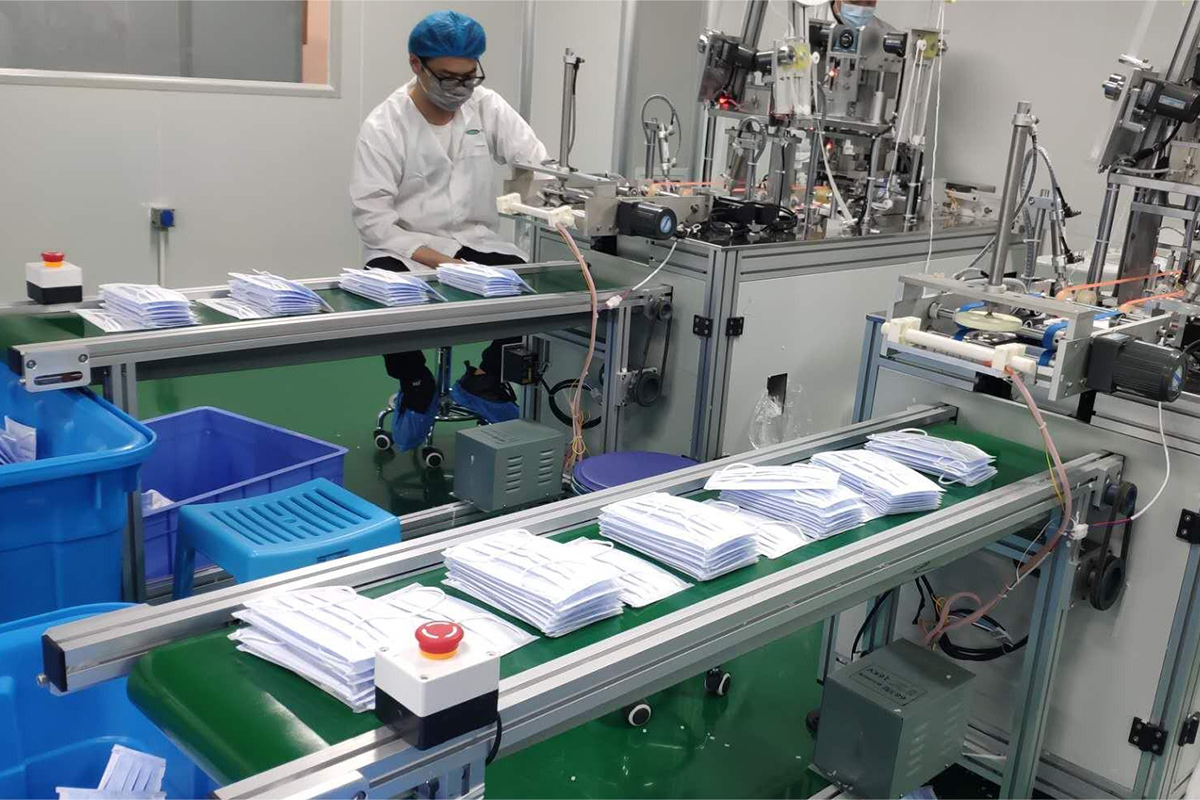
ENGINEERED AROUND EACH PRODUCT STATE
Loose masks are lightweight, flexible and sensitive to surrounding airflow. Small belt gaps or sudden speed changes can rotate, fold or overlap the product before vision inspection and counting.
CSTRANS selects the handling method according to the stage of production:
- Flat-belt conveyors provide continuous support for individual masks and reduce the risk of ear loops entering conveyor gaps.
- Vacuum or hold-down conveying may be considered where lightweight masks must maintain a fixed position at higher speeds.
- Metering conveyors establish consistent pitch before inspection, counting or stacking.
- Segmented belts, pushers or cleated sections transfer counted stacks into the packaging machine without losing stack alignment.
- Flexible chain and modular belt conveyors are more suitable after masks have been bagged, boxed or placed in stable carriers.
- Reject and bypass sections separate defective products without interrupting accepted-product flow.
The main line should be balanced around the slowest repeatable downstream operation, which is often counting, stacking, bagging or cartoning—not the rated output of the mask-forming machine.
BUFFERING BETWEEN PRODUCTION AND PACKAGING
Buffer capacity should be calculated from actual line output and the downstream interruption time:
Buffer quantity = production rate × interruption time
For example, a line producing 120 masks per minute requires capacity for approximately 60 masks to absorb a 30-second packaging interruption, before adding reject gaps and recovery margin.
CSTRANS reviews mask samples, ear-loop construction, production rate, required package quantity, machine-interface heights and available floor space before selecting the conveyor type. Transfer, pitch, stacking and buffer functions can then be tested against the actual product instead of relying only on catalogue conveyor specifications.


