

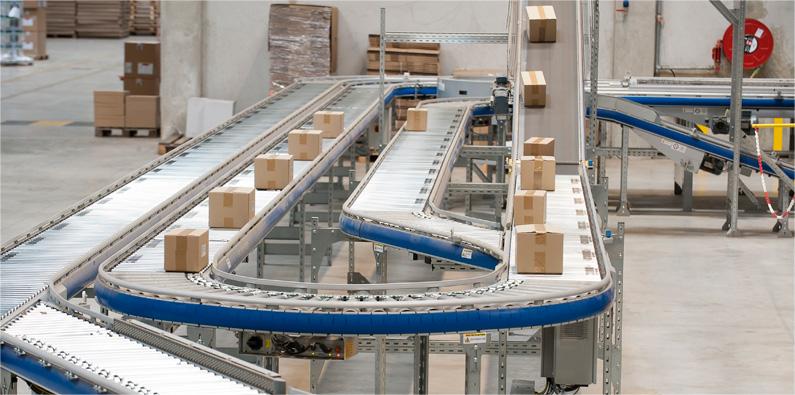
CONTROLLING THE COMPLETE SORTATION FLOW
A typical system may include:
Receiving → singulation → gapping → identification → tracking → diverting → destination lanes → exception handling
Package dimensions alone are not enough to select the equipment. We also confirm:
- minimum and maximum weight;
- base rigidity and surface friction;
- regular cartons, flexible bags or irregular items;
- barcode location and read orientation;
- peak hourly volume and required product gap;
- number and position of destinations;
- acceptable divert impact;
- accumulation available at each discharge;
- recirculation and manual exception strategy.
Flat documents and polybags require continuous support because edges can enter roller or transfer gaps. Stable cartons and totes can run on belt or roller conveyors, while fragile or irregular parcels may require gentler transfers, wider belts or dedicated handling routes.
MATCHING CAPACITY TO THE WHOLE SYSTEM
Sorter capacity cannot be determined from belt speed alone. It is limited by induction accuracy, item length, product gap, scanner read rate, divert cycle, destination availability and the number of items requiring recirculation.
Commercial sorting platforms illustrate how widely capacity can vary by technology: current Interroll vertical cross-belt systems are specified from approximately 2,000 to 12,500 items per hour, while horizontal systems range from approximately 4,000 to 20,000 items per hour. These figures are equipment-specific and should not be used as a guaranteed capacity for a complete logistics line.
CONVEYOR SOLUTIONS FOR LOGISTICS OPERATIONS
CSTRANS can combine:
- belt and roller conveyors for parcels, cartons and totes;
- full-support conveyors for documents, envelopes and polybags;
- metering and gapping sections before scanning or sorting;
- merges, curves and elevation changes for compact routing;
- wheel, belt or mechanical divert sections selected for the package and required outlet geometry;
- destination accumulation lanes and packing-station feeds;
- reject, no-read and oversize-item routes.
Before finalizing the layout, representative items should be tested for tracking, barcode visibility, transfer stability and divert behaviour. Peak-flow simulation should also confirm that induction and destination lanes can support the required sorter rate without creating upstream recirculation or downstream congestion.


