

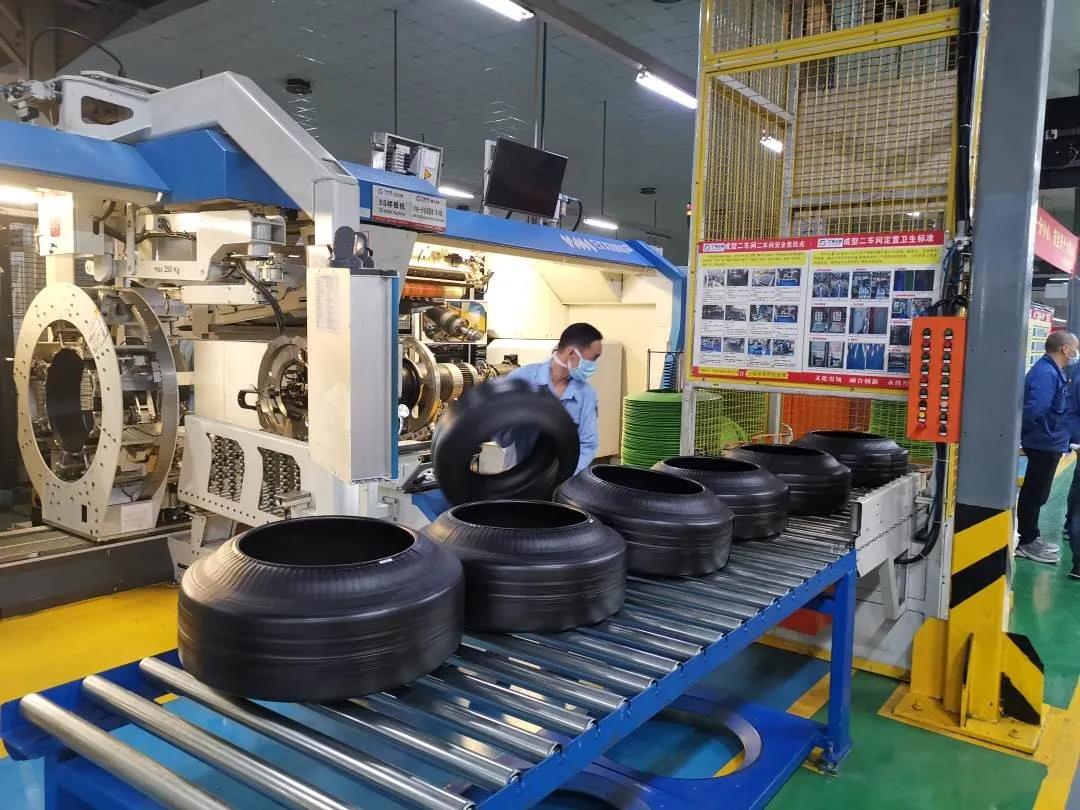
TIRE MANUFACTURING CONVEYOR SYSTEMS
The Green Tire and the Finished Tire Cannot Be Handled the Same Way
Tire plants lose production when green tires wait too long or deform before curing, finished tires queue between inspection machines, or a size change requires repeated adjustment across conveyors, guides and sorting lanes.
The material flow normally passes through:
Tire building → green-tire identification and storage → curing → cooling → inspection → grading and sorting → warehouse
Continental identifies building, vulcanization and final quality control as separate manufacturing stages. Finished tires may then pass through visual inspection, X-ray and uniformity checks before release to the warehouse. Each stage requires a different conveyor function.
CONTROL THE FLOW BEFORE AND AFTER CURING
A green tire has not yet received the final strength and shape created during vulcanization. It should therefore be moved with controlled contact, stable support and transfers that do not distort the tread, bead or sidewall.
After curing, the tire can be handled more robustly, but the line must still maintain:
- tire size and specification identification;
- correct orientation at testing equipment;
- separation of accepted, rejected and rework tires;
- controlled accumulation before inspection;
- routing to the correct sorting or storage lane.
Tire range and machine cycle can vary significantly. One current passenger-tire building platform covers 13–24-inch tires, green-tire diameters up to 900 mm, and published cycle times of 37 seconds for one 205/55R16 construction and 42 seconds for one 215/65R16 construction. Its stated size-change time ranges up to 8 or 18 minutes, depending on the change required. These are machine-specific figures, but they show why conveyor capacity and adjustment range must be based on the actual tire matrix rather than one nominal size.
At a 37-second building cycle, output is approximately 97 green tires per hour. A 10-minute interruption at the curing feed can therefore create about 16 tires requiring controlled storage or rerouting. The storage method must preserve tire identity and avoid damaging uncured products.
CONVEYOR SOLUTIONS ACROSS THE TIRE PLANT
CSTRANS can configure:
- belt conveyors for green-tire transfer and controlled support;
- lift, turn and transfer sections between building, storage and curing;
- roller conveyors for cured tires and rigid carriers;
- accumulation zones before cooling and inspection;
- barcode or RFID tracking interfaces;
- routing for visual, X-ray and uniformity testing;
- sorting lanes for accepted, rework and rejected tires;
- spiral or elevation conveyors where floor space is restricted.
Uniformity inspection may measure run-out, bulges and dents, so the conveyor must deliver each tire consistently to the test station without losing identification or orientation.
CSTRANS sizes the system from the tire diameter, width, weight, green or cured condition, machine cycles, changeover matrix, permitted contact points and required storage quantity. The result is a controlled tire flow—not simply a belt or roller line between machines.


