

Vertical conveyor capacity is calculated from carrier availability, products per carrier, and the time required to load, lift, and discharge each product—not from vertical speed alone. A carrier pitch of 2 m at 0.5 m/s brings one carrier to the loading point every four seconds, or 15 carriers per minute; two products per carrier raise the theoretical capacity to 30 products per minute. The 30-product rate is valid only when infeed and outfeed each complete within the same four-second window; a six-second loading cycle cuts usable capacity to 10 carriers, or 20 products, per minute.
What Does Vertical Conveyor Capacity Mean?
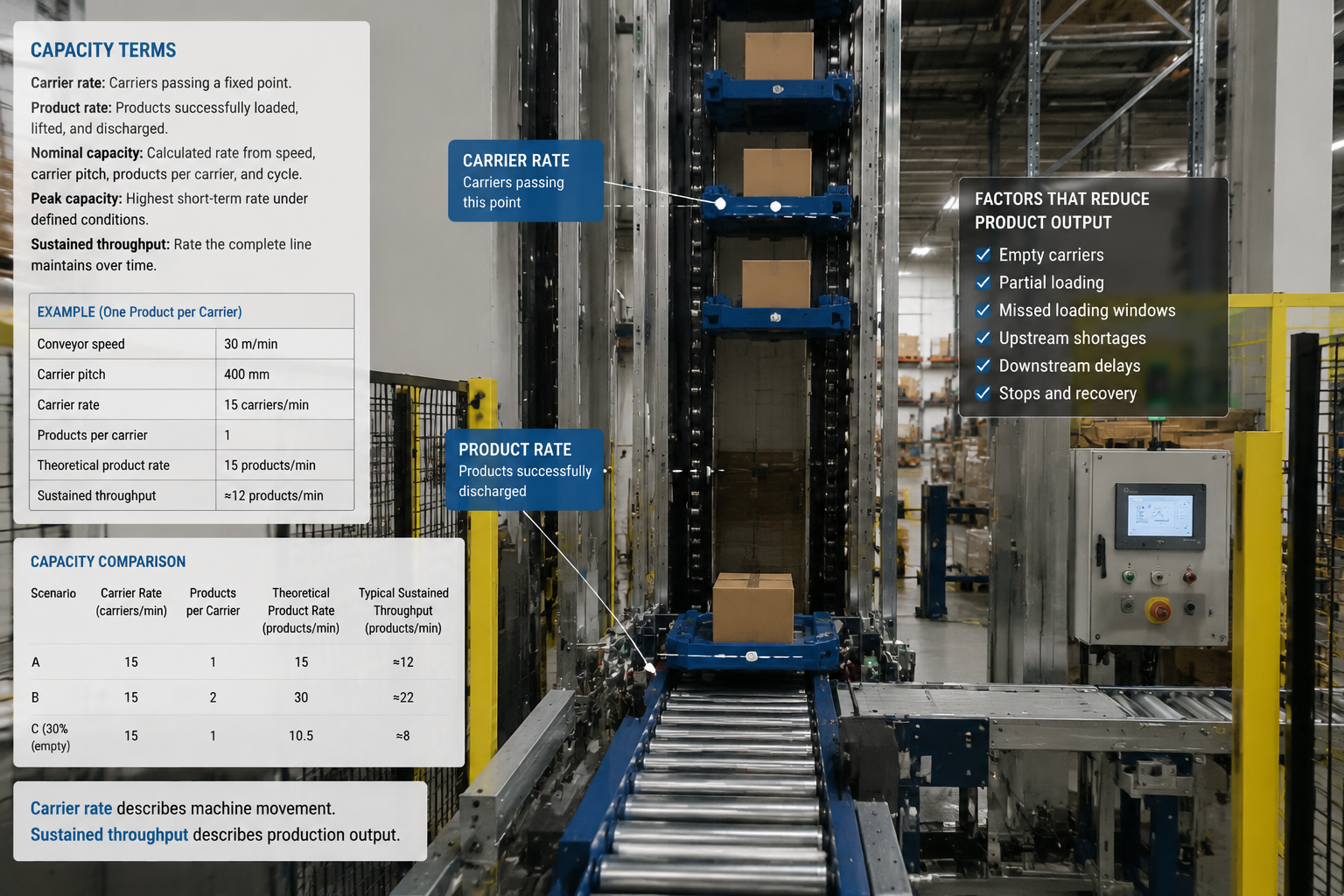
Vertical conveyor capacity must name the output being measured. Carrier rate, product rate, nominal capacity, peak capacity, and sustained throughput are not the same value.
Continuous and reciprocating vertical conveyors use different capacity models. A continuous vertical conveyor starts with carrier arrival frequency, products per carrier, and transfer-cycle capacity. A reciprocating vertical conveyor or VRC starts with products per trip and the complete carriage cycle. Do not apply the carrier-pitch formula to a reciprocating carriage system.
Carrier rate counts the carriers passing a fixed infeed or outfeed point, normally in carriers per minute or hour. Product rate counts the products successfully loaded, lifted, and discharged. Carrier rate and product rate match only when every carrier receives the planned product quantity. Empty carriers, partial loading, missed loading windows, and upstream shortages reduce product output without changing carrier movement.
Nominal capacity is the calculated rate from conveyor speed, carrier pitch, products per carrier, and transfer cycle. Peak capacity is the highest short-term rate achieved with a defined product and operating condition. Sustained throughput is the rate the complete line maintains after normal supply gaps, downstream delays, stops, and recovery are included.
A conveyor moving 15 carriers per minute does not automatically deliver 15 products per minute. One product per carrier produces a theoretical rate of 15 products per minute. Two products per carrier produce 30 products per minute. Empty or partially loaded carriers reduce actual product output even when the carrier rate remains unchanged.
Capacity calculations must use the approved product range, carrier arrangement, and operating layout described in this vertical chain conveyor design and selection guide.
How Do Carrier Pitch and Speed Determine Theoretical Capacity?
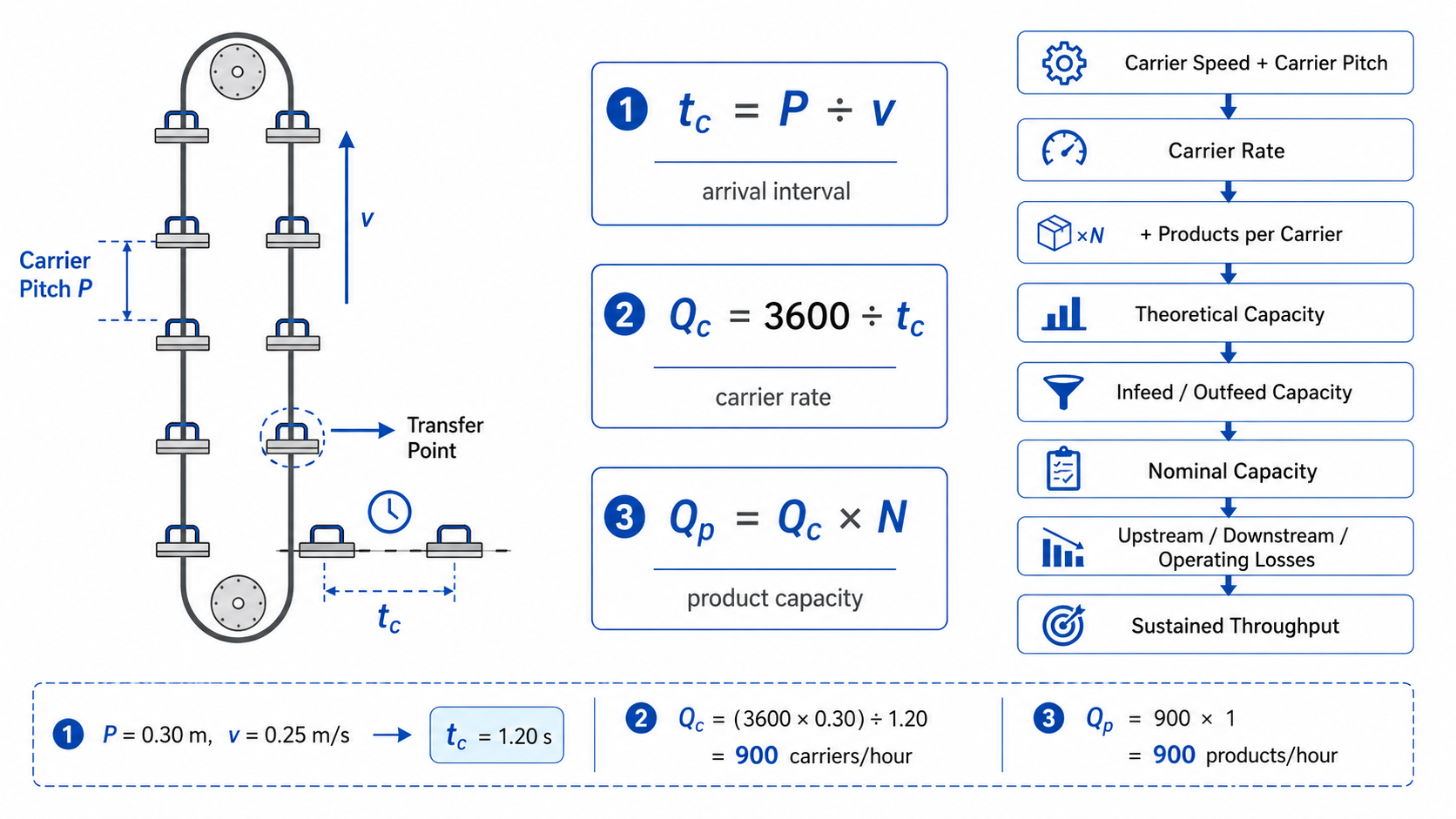
Carrier pitch and carrier travel speed set the theoretical carrier frequency of a continuous vertical conveyor. Product length alone does not set carrier pitch. The pitch must also allow for carrier geometry, the largest approved product, transfer clearance, and separation between adjacent loads.
The theoretical carrier rate is:
Qc=1.203600×0.30=900 carriers/hourWhere:
- (Q_c) = theoretical carrier rate, carriers/hour
- (Q_p) = theoretical product capacity, products/hour
- (v) = actual carrier travel speed, m/s
- (P) = carrier pitch, m/carrier
- (N) = verified products per carrier
Use carrier travel speed, not motor speed. Use only a loading quantity that the carrier can support, retain, and discharge reliably. The calculation also assumes that every carrier position is available for loading.
Reference Calculation
Assume:
- Carrier travel speed: 0.30 m/s
- Carrier pitch: 1.20 m
- Products per carrier: 1
The theoretical carrier rate is:
Qp=900×1=900 products/hourThe result means one carrier reaches the loading point every four seconds. The 900-product rate is achieved only when the infeed, outfeed, and downstream equipment can complete each cycle within the same four-second window.
Vertical Conveyor Capacity Formula
P = carrier pitch, m/carrier
v = actual carrier travel speed, m/s
N = verified products per carrier
tc = carrier arrival interval, s/carrier
Qc = theoretical carrier rate, carriers/hour
Qp = theoretical product capacity, products/hour
Step 1 — Carrier Arrival Interval
tc = P ÷ v
This is the time between consecutive usable carriers reaching the transfer point.
Step 2 — Theoretical Carrier Rate
Qc = (3,600 × 0.30) ÷ 1.20 = 900 carriers/hour
Step 3 — Product capacity
Qp = 900 × 1 = 900 products/hour
This 900 products/hour value is theoretical. It is usable only when the infeed and outfeed transfers, upstream supply, and downstream equipment can support the same cycle.
How Does Transfer Cycle Time Limit Vertical Conveyor Throughput?
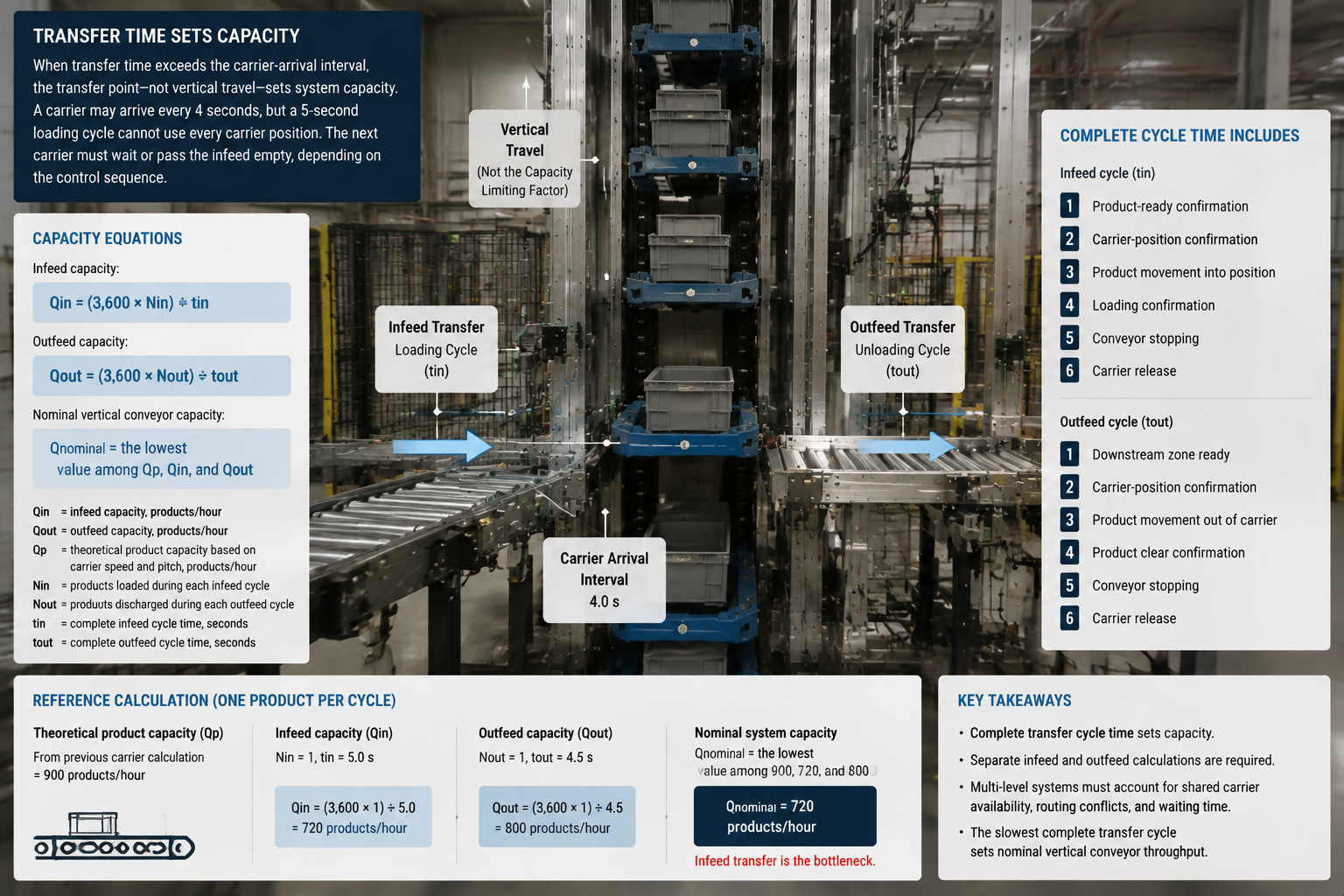
When transfer time exceeds the carrier-arrival interval, the transfer point—not vertical travel—sets system capacity. A carrier may arrive every four seconds, but a five-second loading cycle cannot use every carrier position. The next carrier must wait or pass the infeed empty, depending on the control sequence.
The complete infeed capacity is:
Qin = (3,600 × Nin) ÷ tinThe complete outfeed capacity is:
Qout = (3,600 × Nout) ÷ toutThe nominal vertical conveyor capacity is:
Where:
- Qin = infeed capacity, products/hour
- Qout = outfeed capacity, products/hour
- Qp = theoretical product capacity based on carrier speed and pitch
- Nin = products loaded during each infeed cycle
- Nout = products discharged during each outfeed cycle
- tin = complete infeed cycle time, seconds
- tout = complete outfeed cycle time, seconds
Complete cycle time is not motor run time alone. An infeed cycle starts when loading is permitted and ends when the loaded carrier can be released. The cycle includes product-ready confirmation, carrier-position confirmation, product movement, loading confirmation, conveyor stopping, and carrier release.
The outfeed cycle follows the same rule. The carrier remains occupied until the downstream zone is ready and the product fully clears the carrier. The alignment, sensor, and clearance conditions included in this timing are explained in this guide to vertical conveyor transfer design.
Reference Calculation
The previous carrier calculation produced a theoretical product capacity of 900 products per hour.
For one product loaded during a complete 5.0-second infeed cycle:
Qin = (3,600 × 1) ÷ 5.0

Qin = 720 products/hour
For one product discharged during a complete 4.5-second outfeed cycle:
Qout = (3,600 × 1) ÷ 4.5

Qout = 800 products/hour
The nominal system capacity is:
Qnominal = the lowest value among 900, 720, and 800

Qnominal = 720 products/hour
The infeed transfer is the bottleneck. Increasing vertical travel speed or adding more theoretical carrier positions will not raise system output until the infeed cycle improves.
Infeed and outfeed require separate calculations because transfer distance, product quantity, confirmation time, and downstream conditions can differ. Multi-level systems must also account for shared carrier availability, routing conflicts, and waiting time at each level.
How Should Sustained Vertical Conveyor Capacity Be Calculated and Verified?
Sustained vertical conveyor capacity is the output the complete line can maintain over a defined operating period. A short maximum-rate test does not prove sustained production. Upstream supply, carrier use, transfer cycles, downstream availability, product changes, normal stops, and recovery all affect the delivered rate.
The first capacity check is:
Qsystem = min(Qp, Qin, Qout, Qupstream, Qdownstream)Where:
- Qp = theoretical product capacity from carrier speed and pitch
- Qin = infeed transfer capacity
- Qout = outfeed transfer capacity
- Qupstream = sustainable upstream supply rate
- Qdownstream = sustainable downstream receiving rate
The lowest stage identifies the initial bottleneck. The calculation does not yet include empty carriers, product changes, temporary blockage, missed loading windows, faults, or restart time.
Measured sustained throughput is:
Qsustained = (Ncompleted ÷ Telapsed) × 3,600Where:
- Ncompleted = products successfully discharged during the test
- Telapsed = total elapsed test time in seconds
The test window must include the normal stops, waiting periods, and recovery conditions expected during production. Excluding those periods produces a net running rate, not sustained line throughput.
Do not apply a standard 80%, 85%, or 90% efficiency factor without project evidence. Capacity loss must come from the actual product mix, carrier-loading pattern, operating schedule, expected interruptions, and test results.
Verification must cover:
- Minimum, maximum, and least stable approved products
- Fully loaded, partly loaded, and empty carriers
- Normal supply variation and missed loading opportunities
- Temporary downstream blockage and controlled restart
- Required infeed and discharge levels
- Normal rate and defined short-term peak rate
- Jams, failed transfers, timeouts, damage, and unplanned stops
Multi-level systems require an additional check because several routes share the same carriers. Demand at one level can delay another route even when each transfer point appears to have enough capacity when calculated separately.
Repeated jams and failed transfers reduce sustained output without changing the theoretical carrier rate. Recurring failures should be investigated using the fault patterns in this guide to vertical conveyor jam causes.
Vertical conveyor capacity is not one number. Carrier pitch and speed set theoretical availability; infeed, outfeed, upstream supply, and downstream acceptance set the nominal limit; normal stops and recovery set sustained throughput. Report nominal, peak, and sustained capacity separately, with the product and operating conditions behind each value. Send CS Conveyor your product size, products per carrier, target rate, lift height, and transfer details for a capacity review and quotation.
Frequently Asked Questions
1. Can vertical conveyor capacity be calculated from speed alone?
No. Speed and carrier pitch calculate only the theoretical carrier frequency. Product capacity must also include verified products per carrier, complete infeed and outfeed cycle times, upstream supply, and downstream receiving capacity. The lowest-capacity stage sets the nominal system limit.
2. How does carrier pitch affect continuous vertical conveyor throughput?
At the same carrier speed, a shorter pitch increases carrier frequency. Carrier pitch must still provide enough space for the carrier structure, largest approved product, transfer clearance, and loading window. A shorter pitch adds no usable output when the transfer cycle cannot load or discharge each arriving carrier.
3. Can loading two products on each carrier double capacity?
Two products per carrier double theoretical product capacity only when both products can be loaded, supported, positioned, and discharged within the existing cycle. Longer loading time, sequential discharge, poor load distribution, or unstable spacing reduces the gain. Products per carrier must come from a verified loading pattern, not available carrier space alone.
4. Why is actual throughput lower than calculated capacity?
Theoretical capacity assumes available carriers and uninterrupted transfers. Empty carriers, irregular product supply, slow loading, downstream blockage, product changes, sensor delays, routing conflicts, faults, and recovery reduce delivered output. Nominal capacity includes calculated process limits, while sustained throughput measures completed products over the full operating period.
5. How is reciprocating vertical conveyor capacity calculated?
A reciprocating vertical conveyor uses the complete round-trip cycle:
Capacity = (3,600 × products per cycle) ÷ complete cycle time in secondsComplete cycle time includes loading, position confirmation, vertical travel, discharge, return travel, dwell time, and door or interlock operation where fitted. One-way lifting time alone overstates capacity.
6. What capacity margin should be added to a vertical conveyor?
No fixed percentage applies to every project. Capacity margin must reflect the required peak rate, peak duration, product variation, supply gaps, downstream stops, recovery time, and credible future demand. Extra carrier speed cannot compensate for an infeed or outfeed cycle that remains below the required rate.
Post time: Aug-05-2026


