

Think of a continuous vertical conveyor like an escalator and a VRC like an elevator. An escalator keeps many steps moving in a loop, while an elevator uses one cab that travels up and down. The same basic difference separates these two vertical conveyor systems.
A continuous vertical conveyor keeps several carriers moving through the lift, so products can enter and leave in a repeated flow. A VRC moves one carriage between levels, completes the transfer, and then starts the next trip.
That difference changes more than speed. A line sending cartons or totes every few seconds has a very different job from a warehouse moving one pallet or mixed load every few minutes.
So which system fits your line? Start with three questions: What are you moving, how often does a load arrive, and does the next load need to move before the previous trip is complete?
What Is the Difference Between a Continuous Vertical Conveyor and a VRC?
The motion pattern is only the first difference. A continuous vertical conveyor creates repeated transport opportunities with several circulating carriers. A VRC creates a new transport opportunity each time one carriage completes the required trip.
That difference changes capacity, load handling, transfers, and level control.
| Design factor | Continuous vertical conveyor | VRC |
|---|---|---|
| Motion | Multiple carriers circulate through a closed path | One carriage moves back and forth between levels |
| Next load | Another carrier can arrive while earlier loads are still in the system | The next move depends on carriage position and availability |
| Capacity basis | Carrier pitch, travel speed, products per carrier, and transfer cycle | Products or load per trip and the complete carriage cycle |
| Load support | Product must fit a carrier, fork, shelf, or platform | Load is supported on one carriage or platform |
| Transfer | Repeated infeed and outfeed windows must match carrier arrival | Transfer begins after the carriage reaches and confirms the required level |
| Multiple levels | Shared carriers and routing logic divide available capacity between levels | One carriage serves the requested levels in sequence |
| Typical system role | Repeated conveyor-fed unit-load flow | Floor-to-floor, pallet, cart, batch, or automated carriage transport |
Continuous Vertical Conveyor
For a continuous vertical conveyor, the key question is how often the next usable carrier reaches the transfer point. Product size also matters because larger products require more carrier space and can reduce the number of available carrier positions.
Qimarox, for example, lists a current continuous model at up to 2,000 products/hour, with up to 50 kg (110 lb) per carrier, product sizes up to 900 × 610 mm, and lift heights around 17.3 m (56 ft 10 in).
VRC (Reciprocating)
For a VRC, the key question is how much one carriage can move and how long the complete trip takes. VRC capability varies widely. One hydraulic PFlow model is rated up to 3,000 lb, uses a carriage up to 6 × 6 ft, travels at 17–25 ft/min, and is rated for 10 cycles/hour.
A mechanical PFlow VRC: the M Series handles up to 10,000 lb, uses a standard 12 × 10 ft carriage, and is offered for high-speed, high-cycle automated applications.
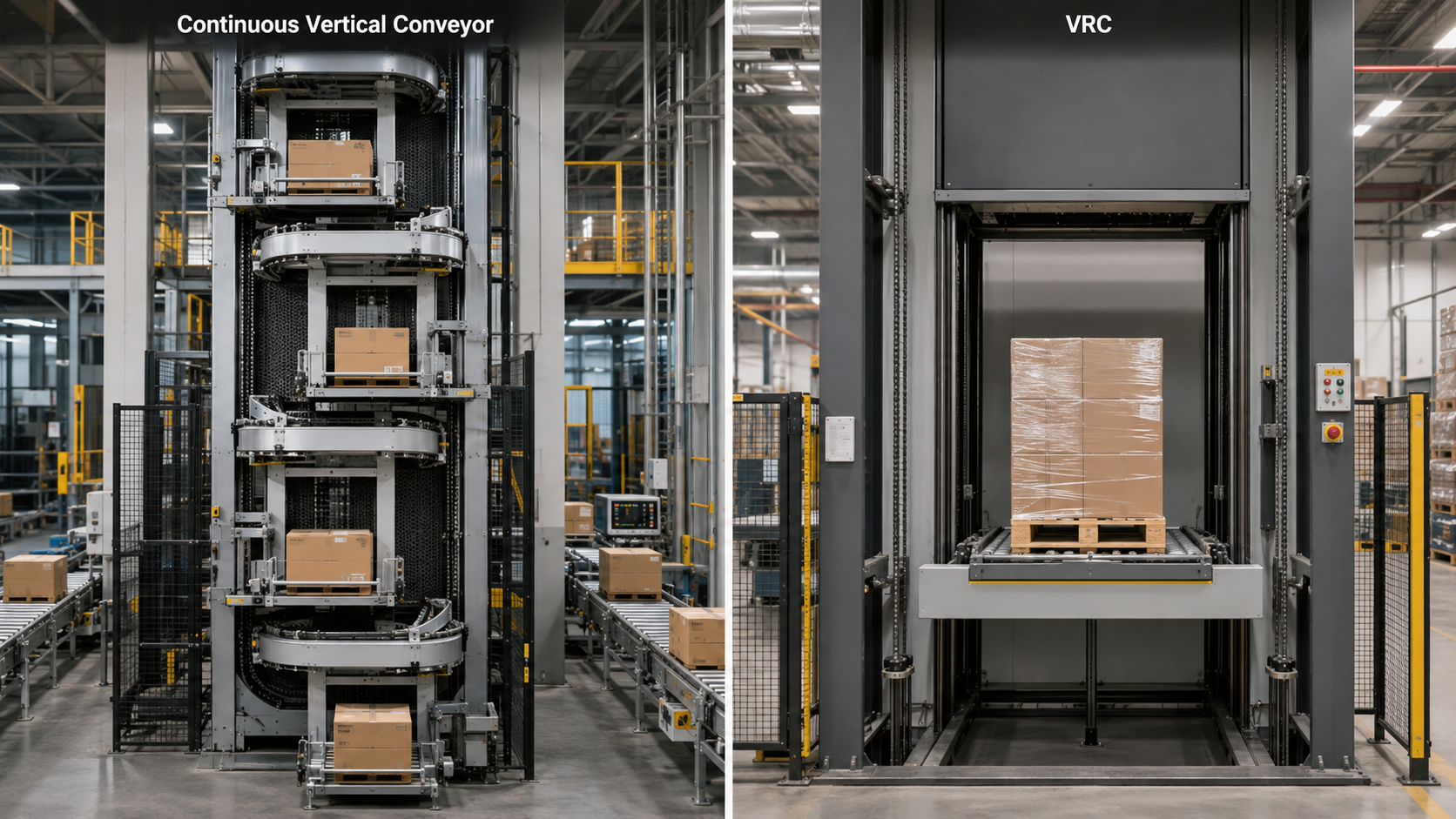
The numbers expose an important selection mistake: “continuous” does not automatically mean fast and light, and “VRC” does not automatically mean slow and heavy. Published capacity belongs to a specific machine, load, travel distance, transfer sequence, and operating condition.
A line receiving cartons every few seconds needs frequent transport opportunities. A pallet operation moving one complete load at a time needs enough carriage capacity and a short enough round-trip cycle.
How Do Throughput and Cycle Time Affect the Choice?
A continuous vertical conveyor and a VRC run on different clocks. A continuous system asks, “When does the next carrier arrive?” A VRC asks, “When is the carriage ready for the next trip?”
For a continuous vertical conveyor, capacity starts with carrier pitch and travel speed. Transfer time then decides whether each arriving carrier can actually be used. More carriers can increase transport opportunities, but only when the infeed and outfeed can keep up. For the full calculation, see the vertical conveyor capacity calculation.
For a VRC, one complete carriage cycle sets the basic rate:
A faster lift shortens only part of that cycle. Door or interlock time, loading, unloading, level stops, and the next destination also consume time.
This is why high throughput does not automatically mean “choose continuous,” and a VRC does not automatically mean “low throughput.” Mechanical VRCs can be built for continuous, high-cycle automated duty; PFlow’s M Series, for example, is specified for unlimited cycles and high-speed applications. Continuous conveyors can reach much higher product frequencies when small unit loads arrive in a steady stream; one current Qimarox continuous model is rated up to 2,000 products per hour in its defined configuration.
Consider two very different lines:
- One carton every 4 seconds: 900 transport opportunities per hour are required. A continuous carrier loop is a natural place to start.
- One pallet every 45 seconds: 80 trips per hour are required. A VRC can remain practical if the complete carriage cycle stays below 45 seconds.
The second example does not prove that a VRC will work; travel height, loading time, discharge time, number of levels, and carriage load still have to be calculated.
The real comparison is not vertical speed. It is the time until the next usable transport opportunity.
How Do Load, Levels, and Transfer Layout Affect the Selection?
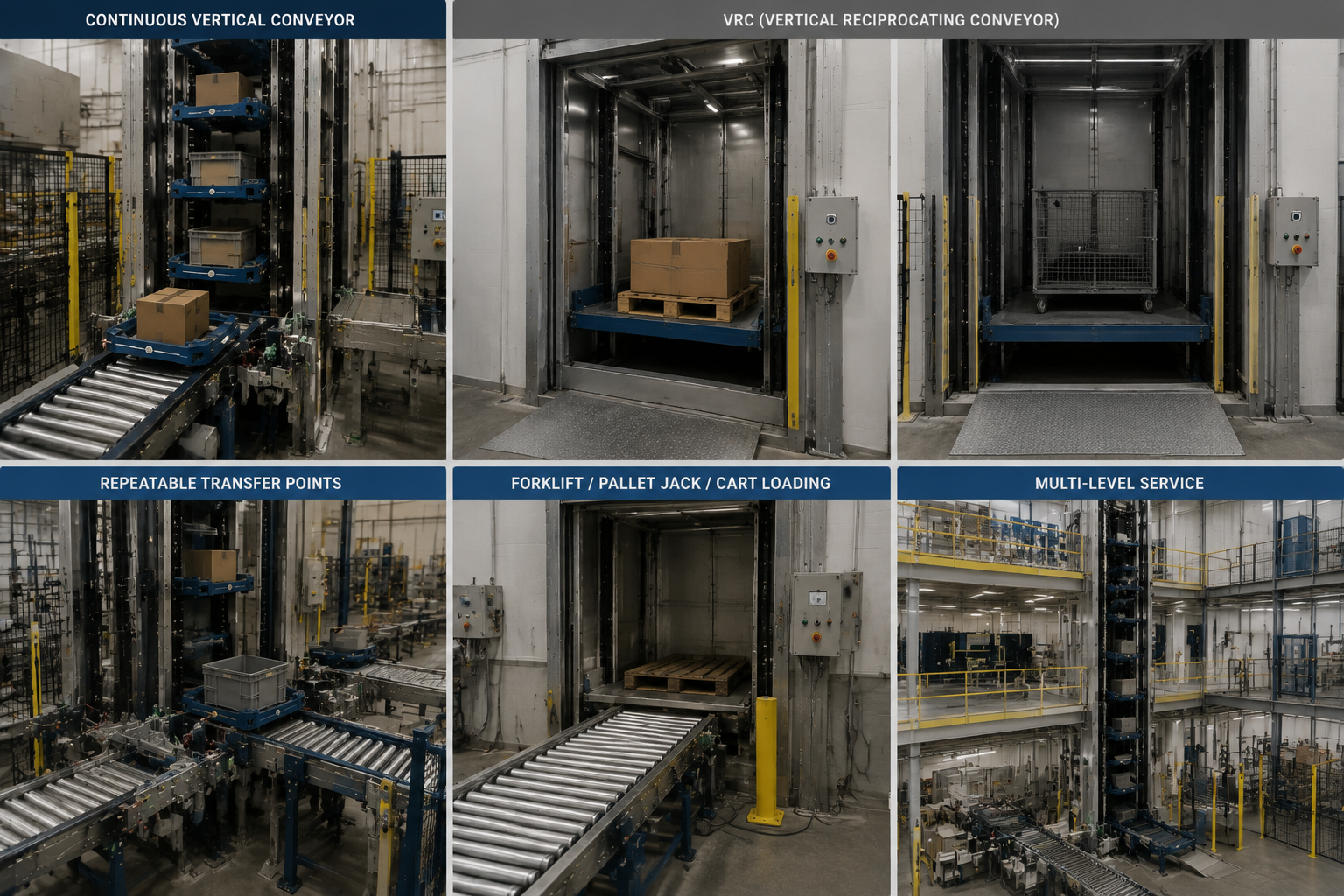
Throughput can point toward one system, but the load can change the answer. Start with three questions: How does the load sit, how does the load enter and leave, and how many levels must the lift serve?
How Does the Load Sit?
A continuous vertical conveyor works best when every approved product can sit securely on the same carrier design. Cartons, totes, trays, and other stable unit loads are good candidates when the product base, center of gravity, and size range stay inside the carrier envelope.
A VRC gives the load one carriage or platform for the trip. That makes a VRC easier to adapt to pallets, carts, equipment, oversized loads, or mixed footprints when one carrier design would become too restrictive.
Weight alone does not decide the choice. A tall 200 lb load with a high center of gravity can be harder to transfer than a stable 1,000 lb pallet.
How Does the Load Enter and Leave?
Continuous systems depend on repeatable transfer points. Carrier height, transfer gap, product position, and infeed/outfeed timing must work on every cycle.
A VRC can be loaded by conveyor, forklift, pallet jack, cart, or another handling device. The loading method changes carriage size, gate location, approach space, and control requirements.
For automated transfers, use the same alignment, gap, and timing checks described in this vertical conveyor transfer design guide.
How Many Levels Must Be Served?
A VRC carriage can stop at several fixed levels, but every added stop becomes part of the carriage schedule. More stops can increase waiting time when several floors request the same carriage.
A continuous vertical conveyor can also serve multiple levels. Adding more infeed or discharge points requires more transfer hardware, destination control, and shared carrier capacity. Multi-level continuous systems can even operate as vertical sorters when the transfer arrangement is designed for that purpose.
Layout must therefore include more than the lift footprint. Check the carrier return path, carriage approach area, transfer conveyors, gates, floor openings, headroom, guarding, and maintenance access.
How Should You Choose Between a Continuous Vertical Conveyor and a VRC?
The choice becomes much easier once flow pattern and load support are clear. A continuous vertical conveyor fits repeated unit-load movement when products arrive often, use a consistent carrier, and transfer through fixed infeed and outfeed points. A VRC fits better when one carriage can handle the required load and complete each trip within the available cycle time.
Continuous vertical conveyors are usually the stronger fit for cartons, totes, trays, and other stable loads moving through an automated conveyor line. VRCs are often easier to apply to pallets, carts, machinery, oversized loads, or mixed footprints that benefit from one larger platform.
Multiple levels change the comparison. A continuous system shares carriers between transfer points, so more levels add routing and carrier-demand conflicts. A VRC shares one carriage between transport requests, so more levels add stops, travel, and waiting time. High throughput alone does not select a continuous conveyor. Heavy load alone does not select a VRC. Compare both systems when the application sits between those two patterns.
A continuous vertical conveyor and a VRC solve the same vertical movement problem in different ways. Continuous systems create repeated carrier opportunities for predictable unit-load flow, while a VRC completes one carriage-based transport cycle at a time. The right choice is not the machine with the highest speed or load rating, but the system that can move the approved load at the required sustained rate with the simplest reliable transfer path.
Send CS Conveyor your load size, weight, required rate, lift levels, and layout for a vertical conveyor selection review and quotation.
Frequently Asked Questions
1. Is a VRC the same as a vertical conveyor?
A VRC is one type of vertical conveyor. “Vertical conveyor” is the broader category, while a VRC specifically uses a reciprocating carriage or platform to move materials between levels. A continuous vertical conveyor instead circulates multiple carriers through a closed path.
2. Is a continuous vertical conveyor always faster than a VRC?
No. A continuous vertical conveyor can provide more frequent transport opportunities, but a high-cycle VRC can also achieve substantial throughput. Compare sustained loads per hour from the complete cycle, not vertical travel speed alone.
3. Which is better for pallets, a continuous vertical conveyor or a VRC?
A VRC is often the first option for pallets because one carriage can support the complete pallet load. High-throughput pallet applications may also justify a continuous pallet lift, so pallet size, weight, cycle time, and required rate should be calculated before selection.
4. Can a VRC be integrated into an automated conveyor line?
Yes. A VRC can use powered conveyor interfaces, sensors, PLC controls, and automatic level calls. Automation does not define the equipment type; reciprocating carriage motion does.
5. Which system is better for multiple floors?
A VRC often provides simpler point-to-point service between several fixed levels. A continuous vertical conveyor can also serve multiple levels, but additional transfer points increase routing, carrier coordination, and control requirements. Compare route demand rather than floor count alone.
6. Which system requires less floor space?
Neither system is always smaller. Compare the complete installation, including the lift structure, carrier return path or carriage access, transfer conveyors, gates, guarding, floor openings, and maintenance clearance.
Post time: Aug-13-2026


