

A vertical chain conveyor is a dedicated lifting system for stable unit loads between fixed elevations. It is not a universal vertical conveyor for unstable products or loads that cannot maintain a controlled position during lifting and transfer. Selection depends on load stability, transfer method, throughput requirements, and installation constraints.
Unlike conveyors that use chains only as a drive mechanism, a vertical chain conveyor moves unit loads on chain-driven carriers, forks, shelves, or platforms. Vertical chain conveyor design must keep the load supported, the chains synchronized, and every loading and discharge position repeatable. Selecting the system by lift height or chain capacity alone can still produce unstable handling, poor transfers, and integration problems.
Is a Vertical Chain Conveyor Right for Your Product Flow?
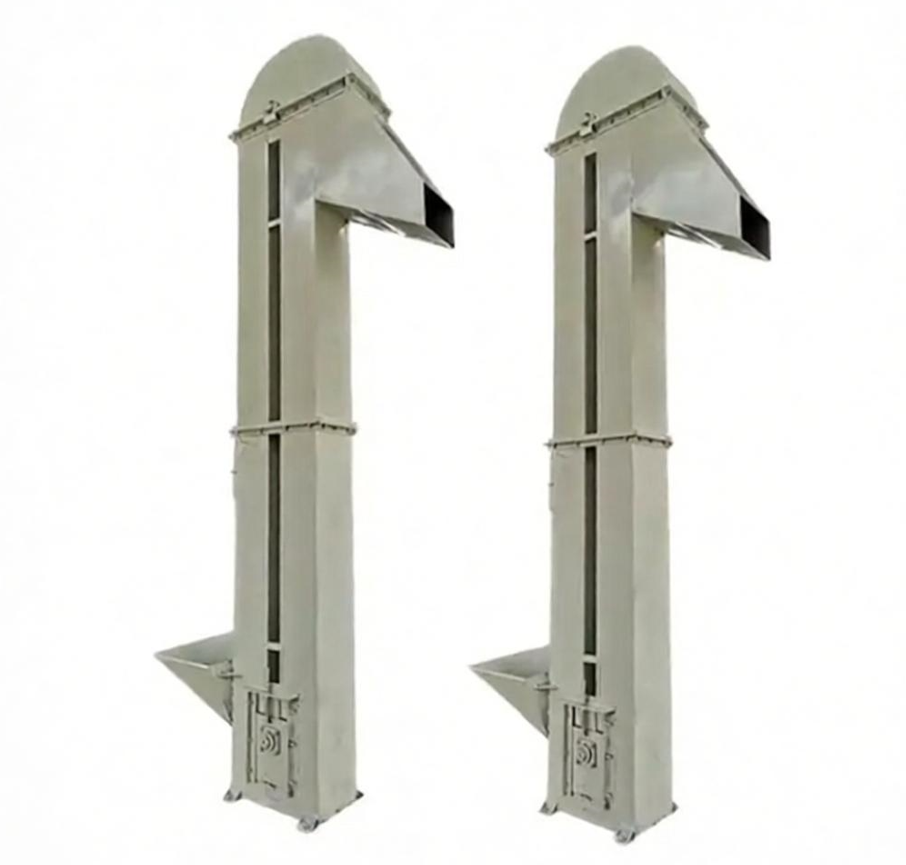
A vertical chain conveyor fits only unit loads that can enter, rise, and exit without losing position. Food, packaging, or warehouse use does not prove suitability. The product must stay stable at every carrier and transfer point.
Product weight sets the required load capacity. Product base, rigidity, center of gravity, and orientation determine whether the load can transfer without tipping, sliding, rolling, or jamming.
Within this guide, vertical chain conveyor refers to a carrier-based continuous vertical conveyor. A chain-driven reciprocating platform is evaluated as a Vertical Reciprocating Conveyor (VRC).
| Selection condition | Continuous vertical chain conveyor | VRC | Spiral conveyor |
|---|---|---|---|
| Movement pattern | Multiple carriers move through a fixed vertical path | A carriage moves up and down between defined levels | Products move continuously on a helical conveying surface |
| Best flow type | Repeated carrier-based unit-load flow | Floor-to-floor movement within a defined carriage cycle | Continuous product flow without separate carrier transfers |
| Load support | Fork, shelf, tray, or platform matched to the product base | Carriage or platform supporting the complete load | Belt, slat, or chain surface supporting the product through curves |
| Product requirement | Stable load with repeatable automatic transfer | Load fully supported during travel, loading, and unloading | Product remains stable on the incline and through every curve |
| Throughput basis | Carrier spacing, carrier count, travel speed, and transfer cycle | Travel time, dwell time, and loading and unloading time | Conveyor speed, product spacing, incline, and path length |
| Layout | Compact vertical path with defined infeed and discharge points | Vertical shaft with defined level stops | Larger helical footprint with continuous entry and discharge |
| Main selection risk | Carrier geometry or transfer interface does not match the product | Carriage cycle, load support, or loading force does not match the duty | Product slips, tips, rotates, or jams on the curved incline |
Generally Suitable
- Rigid cartons
- Totes
- Trays
- Crates
- Stable packaged products
- Drums or kegs with shaped support
- Pallets on a conveyor designed and rated for pallet loads
Requires Engineering Verification
- Soft bags
- Products with uneven bottoms
- Mixed product sizes
- Tall loads with high centers of gravity
- Products that can roll or slide
- Fragile packages
- Loads requiring a fixed orientation
- Products that cannot cross the planned transfer gap
Not Suitable Without Special Design
- Loose bulk materials
- Uncontained small parts
- Leaking products
- Extremely unstable loads
- Loads larger than the available carrier geometry
- Products that cannot enter or leave the carrier safely
Bulk products and loose parts normally require buckets, enclosed containers, cleated belts, or another handling method designed to contain the material.
Washdown and corrosive service are equipment-environment checks, not product categories. Frame material, chain material, bearings, lubrication, seals, drainage, and electrical protection must match the cleaning process and chemical exposure.
Final selection requires product dimensions, weight, base condition, center of gravity, required orientation, infeed and discharge direction, target rate, vertical travel, number of levels, available footprint, and transfer-point details. Product photos, drawings, or physical samples are required when transfer stability cannot be confirmed from dimensional data.
How Does Vertical Chain Conveyor Design Affect Product Handling?
Vertical chain conveyor design must control every approved unit load, not just carry the required weight. Chain strength is only one mechanical limit. Carrier geometry, vertical conveyor chain selection, chain synchronization, position control, and transfer design determine whether each load remains stable through loading, lifting, and discharge. Transfer alignment, gap, product support, and timing must then be verified at every interface.
- Carrier design: Forks, shelves, platforms, trays, or custom fixtures must support the approved product base and keep the center of gravity inside the usable support area during loading, vertical travel, and discharge. Carrier dimensions must also allow the required transfer clearance without allowing the product to slide, rotate, or tip.
- Chain synchronization: Opposed or parallel chain runs must maintain matched travel and carrier position. Sprocket alignment, shaft alignment, attachment position, take-up adjustment, and chain wear must be controlled so that one side does not move ahead of the other or carry a disproportionate share of the load.
- Carrier pitch: Carrier pitch sets the available transport opportunities but should be selected from the product envelope, loading clearance, transfer cycle, carrier geometry, and required throughput. Smaller spacing can increase theoretical carrier frequency only when infeed and outfeed transfers can use the additional carrier positions.
- Guides and restraints: Tall, round, narrow, or low-friction products need additional control when normal acceleration, deceleration, or transfer forces can change their position. Guides and restraints must stabilize the load without interfering with carrier entry, vertical travel, or discharge.
- Transfer control: Upstream equipment should release a product only after the correct carrier reaches the approved loading position. Downstream equipment must also be available before discharge begins. Product presence, carrier position, transfer-zone clearance, and completed transfer should be confirmed by the appropriate sensors or position feedback.
- Return path and access: A continuous vertical chain conveyor requires a return path for empty carriers. The return path affects equipment height, footprint, guarding, and service access. Layout drawings must reserve usable access to chains, sprockets, take-up points, sensors, guides, lubrication points, carrier attachments, and inspection areas.
How Should a Vertical Conveyor Chain Be Selected?
Vertical conveyor chain selection should start with the combined moving load, not product weight alone. The chain carries the product together with the carrier or fixture, attachments, and the forces introduced by acceleration, starting, stopping, and load distribution. In multi-chain systems, the design must also verify that parallel chains, sprockets, shafts, and take-up positions remain aligned so one chain does not carry a disproportionate share of the load.
Chain pitch must match the selected sprocket and attachment arrangement. Carrier spacing may use several chain pitches, but carrier pitch should still be determined from the product envelope, transfer clearance, and required cycle rather than from chain pitch alone. Attachments and their fastening method must also maintain a repeatable carrier position through repeated operating cycles.
Tensioning and wear allowance belong in the original conveyor layout. Excessive slack can affect sprocket engagement and carrier position, while excessive tension increases loading on the chain, shafts, bearings, and sprockets. Inspection access should allow technicians to check chain elongation, lubrication, attachments, sprocket condition, and equal take-up on parallel chains.
Environment also changes the chain specification. Washdown, corrosion, temperature, dust, and lubrication restrictions can require different materials or lubrication strategies. The correct vertical conveyor chain is therefore selected from load, duty cycle, attachment geometry, sprocket engagement, tensioning, environment, and maintenance requirements—not tensile strength alone.
Mixed Product Sizes
Mixed product sizes must fit within one documented carrier envelope and product-size matrix. The approved matrix must define:
- Product dimensions and weight
- Base condition
- Center of gravity
- Required orientation
- Transfer direction
- Guide and fixture settings
Large size differences require adjustable guides, recipe control, separate fixtures, or different carriers. The largest approved product also sets the minimum carrier spacing.
An acceptable vertical chain conveyor design keeps every approved unit load supported, aligned, and transferable. Chain selection, carrier geometry, and transfer control must work together; required throughput is achieved only when carrier frequency, infeed timing, discharge timing, and downstream capacity all meet the target rate.
Carrier clearance must also be checked across the complete approved size range. The largest product sets the minimum usable carrier envelope, while positioning variation, guides, stops, and transfer accuracy determine how much of that clearance remains available during actual operation. Nominal carrier dimensions alone do not prove that every approved product can load and discharge reliably.
What Determines Vertical Chain Conveyor Throughput, Layout, and Reliability?
Published conveyor speed does not equal usable line output. The slowest verified interface sets sustained throughput. A vertical chain conveyor reaches the target rate only when supply, carrier movement, discharge, blockage control, and recovery support the same operating cycle.
Vertical conveyor throughput must distinguish four values:
- Nominal throughput: Calculated from carrier spacing and conveyor speed.
- Peak throughput: The highest short-term rate under ideal flow.
- Average throughput: Total completed loads divided by total operating time.
- Sustained throughput: The rate maintained during normal supply changes, stops, and recovery.
Selection must meet the required sustained rate, not only the nominal or peak rate.
| Operating factor | Capacity effect | Main project risk |
|---|---|---|
| Carrier pitch | Sets available carrier frequency | Product interference or unused carrier positions |
| Transfer time | Sets loading and discharge rate | Missed carrier, incomplete transfer, or jam |
| Upstream supply | Determines carrier use | Empt cycles and unstable output |
| Downstream capacity | Controls continuous discharge | Waiting carriers and line stoppage |
| Product variation | Changes clearance and timing | Carrier-envelope mismatch |
| Number of levels | Adds routing and confirmation steps | Wrong discharge or longer waiting time |
| Maintenance access | Controls inspection and recovery time | Longer downtime after faults |
Vertical Chain Conveyor Throughput Example
Consider a continuous vertical chain conveyor with the following calculated capacities:
| Cycle element | Calculated capacity |
|---|---|
| Available carrier frequency | 1,000 cartons/hour |
| Infeed transfer | 800 cartons/hour |
| Outfeed transfer | 900 cartons/hour |
The maximum usable rate is:
Minimum of 1,000, 800, and 900 = 800 cartons per hour
A required rate of 900 cartons per hour cannot be met because the infeed transfer is limited to 800 cartons per hour. Higher chain speed or smaller carrier pitch cannot remove that bottleneck.
Operating interruptions reduce sustained output further. Without buffer capacity or catch-up speed, five minutes of blockage during each operating hour reduces output to:
800 × 55 ÷ 60 = 733 cartons per hour
The example shows the difference between calculated capacity and sustained production. The slowest cycle sets the initial limit. Blockage and recovery time reduce the usable rate below that limit.
Layout and Transfer Direction
A vertical chain conveyor can use same-side, opposite-side, right-angle, or multiple-level transfers. C, Z, and S labels describe common arrangements, but configuration names are not universal. Equipment drawings must show:
- Infeed and discharge direction
- Finished-floor elevations
- Product travel direction
- Carrier return path
- Transfer conveyor position
- Guarding and service clearance
Flow arrows and dimensional drawings govern the project—not the configuration letter alone.
Accumulation and Blockage Control
A continuous vertical conveyor does not provide usable accumulation unless the design defines available holding positions and controlled restart logic. Upstream metering or buffering is required when incoming flow can exceed the verified transfer rate. Downstream stop, hold, or divert control is required when discharge equipment can become unavailable.
Blockage logic must prevent additional products from entering an occupied transfer zone. Recovery logic must also define carrier position, product status, restart order, and manual-clearance conditions.
Operating Reliability
Reliable operation requires synchronized product arrival, stable carrier support, matched chain travel, confirmed transfer positions, blockage detection, and controlled fault recovery.
The layout must preserve access to chains, tensioning points, sensors, guides, drives, guards, and jam locations. ASME B20.1 covers conveyor design, installation, maintenance, inspection, and operation in relation to conveyor hazards, which reinforces the need to treat service and recovery access as part of the system design rather than an afterthought.
What Should Be Specified and Compared Before Quotation?
A complete technical specification is not required for an initial quotation. Basic product, capacity, height, and layout data are enough to begin. Missing details can be confirmed during engineering review.
A vertical chain conveyor system should therefore be specified from the product range, required rate, vertical travel, transfer arrangement, environment, and available layout before individual components are finalized.
During the engineering review stage, the following information is required, including but not limited to:
| Required information | What to provide |
|---|---|
| Product | Minimum and maximum size, weight, bottom condition, photos, or drawings |
| Capacity | Required products per hour and operating hours per day |
| Vertical travel | Infeed height, discharge height, and number of levels |
| Layout | Available footprint, flow direction, and site drawing when available |
| Transfers | Upstream and downstream conveyor type and direction |
| Environment | Indoor, outdoor, washdown, dusty, humid, or corrosive conditions |
| Controls | Power supply and required connection with the production line |
Product samples or videos are useful when cartons, totes, trays, drums, or pallets have unusual bases, unstable shapes, or strict orientation requirements.
What Should Be Compared in Supplier Quotations?
Quoted prices are not comparable when supplier scopes are different. Check the main boundaries before choosing a proposal:
- Approved product size and weight range
- Sustained throughput
- Carrier and transfer design
- Included infeed and outfeed equipment
- Guarding and control system
- Installation and commissioning scope
- Drawings, manuals, spare parts, and warranty
- Factory test conditions
A low quotation may exclude transfer conveyors, guarding, controls, installation, or commissioning. Every quotation should therefore state what is included and what remains the customer’s responsibility.
Final approval should confirm the product range, layout, throughput, safety scope, and test conditions. For U.S. projects, applicable requirements such as ASME B20.1 should be reviewed against the actual conveyor design and installation.
A vertical chain conveyor is not selected by lift height alone. Product stability, transfer control, and sustained throughput determine whether the system will work. The slowest transfer—not chain speed—sets the usable output. Send CS Conveyor your product size, weight, required rate, lift height, and layout for an engineering review and quotation.
Frequently Asked Questions
1. Is a vertical chain conveyor the same as a continuous vertical conveyor or a VRC?
Not always. A vertical chain conveyor is a continuous vertical conveyor when multiple carriers circulate through a lifting and return loop, while a VRC uses a reciprocating carriage instead of a continuous carrier loop.
2. How is vertical chain conveyor throughput determined?
Usable throughput equals the lowest verified rate among carrier frequency, infeed transfer, outfeed transfer, and downstream acceptance. Maximum chain speed does not define sustained line output.
3. Can one vertical chain conveyor handle different product sizes?
One vertical chain conveyor handles multiple sizes only when every approved product fits the carrier envelope and remains stable during loading and discharge. Wide size variation requires adjustable guides, recipe settings, separate fixtures, or different carriers.
4. What causes products to jam during vertical transfer?
Most jams begin at the transfer points, not during vertical travel. Common causes include poor product position, unstable bases, transfer-gap mismatch, timing errors, downstream blockage, and loss of chain synchronization.
5. What information is needed for a vertical chain conveyor quotation?
Provide product dimensions, weight, photos, required sustained rate, lift height, transfer direction, number of levels, environment, and a simple layout. CS Conveyor can use these details to review the application, identify the correct conveyor type, and prepare an initial quotation.
6. How is a vertical conveyor chain selected?
Vertical conveyor chain selection depends on more than product weight. Check the combined load of the product, carrier, and attachments; chain pitch and sprocket engagement; parallel-chain synchronization; take-up and wear allowance; duty cycle; and lubrication or environmental limits. The selected chain must maintain carrier position and load sharing through repeated lifting and transfer cycles.
Post time: Jul-28-2026


