

Vertical conveyor blockage control should stop new product release before an occupied downstream zone becomes a jam. The control system must know whether the receiving zone is clear, where products are waiting, and whether buffer space remains.
A downstream occupied condition is not the same as a transfer fault or safety stop. Each state needs a different response.
Buffer short interruptions, stop upstream release before the buffer fills, and restart only after product position, carrier status, and downstream availability are confirmed.
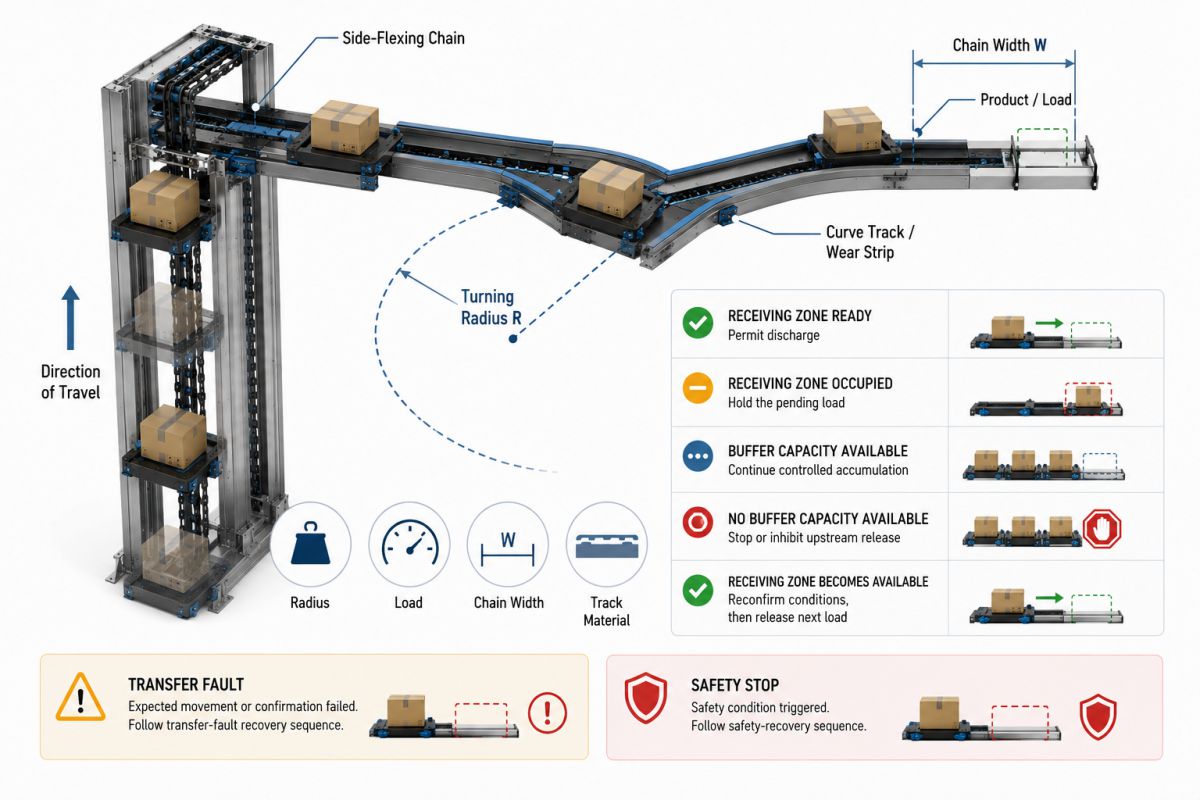
Downstream Blockage Response Logic
A downstream blockage should first answer one question: can the system safely accept another product? Vertical motion alone does not mean another load should enter the lift or leave the carrier.
Outfeed should depend on a confirmed receiving state, not a fixed delay.
| Material-flow state | Control response |
|---|---|
| Receiving zone ready | Permit discharge |
| Receiving zone occupied | Hold the pending load |
| Buffer capacity available | Continue controlled accumulation |
| No buffer capacity available | Stop or inhibit further upstream release |
| Receiving zone becomes available | Reconfirm the required conditions, then release the next load |
A clear sensor does not automatically mean downstream ready. The receiving zone may also need the correct route, conveyor enable, transfer permission, and no blocking process condition before another product is released.
Buffer capacity must also be defined, not assumed. An empty carrier or open conveyor position counts as buffer only when the control system can safely reserve that position, track the product, and preserve the required carrier sequence. Zero-pressure accumulation systems use the same principle: products are held in controlled zones and released according to downstream availability rather than allowed to accumulate without defined positions.
The permitted hold and buffer positions must remain within the carrier and operating limits of the vertical chain conveyor design and selection guide.
A transfer fault is different from normal downstream occupancy: an expected movement or confirmation failed. A safety stop belongs to a separate safety-recovery sequence. Neither condition should be treated as ordinary accumulation.
Good blockage control stops accepting products before the last safe buffer position is consumed—not after the transfer point is already full.
Buffer Sizing and Upstream Release Control
A buffer should be sized in usable load positions and interruption time, not conveyor length alone. A 5 m conveyor tells very little until product length, spacing, zone arrangement, and existing occupancy are known.
The first calculation should include products that are already committed to the buffer:
Bfree = Btotal - Boccupied - Bcommitted
Bcommitted includes loads already released upstream that cannot be stopped or redirected before reaching the buffer.
For a complete downstream stop:
tbuffer = (3,600 × Bfree) ÷ Qin
where Qin is the incoming rate in loads/hour and tbuffer is the remaining coverage time in seconds.
If downstream continues running at a reduced rate:
tfill = (3,600 × Bfree) ÷ (Qin - Qout)
This applies when Qin > Qout. If downstream can accept loads as fast as they arrive, the buffer does not continue filling.
Each usable position must safely contain an approved load and maintain the required separation from the next controlled position. In a zone-based zero-pressure system, occupied zones prevent the following load from advancing until downstream space becomes available. Mixed-product lines must also verify that the zone and detection logic work for the approved product range.
Upstream release should stop before the final physical position is occupied. Enough capacity must remain for every committed load already moving toward the buffer. Once downstream recovers, products should be released only as fast as the receiving process can accept them.
Buffering buys recovery time; buffering does not create sustained capacity. If incoming demand remains higher than downstream capacity, every finite buffer eventually fills. Long-term flow balance should be checked separately using the vertical conveyor capacity calculation.
Restart Logic After Blockage or Fault
Resetting an alarm does not restore the material-flow state. Before restart, the control system must know where the products are, which carriers are occupied, whether a transfer is complete, and whether the downstream zone can accept another load.
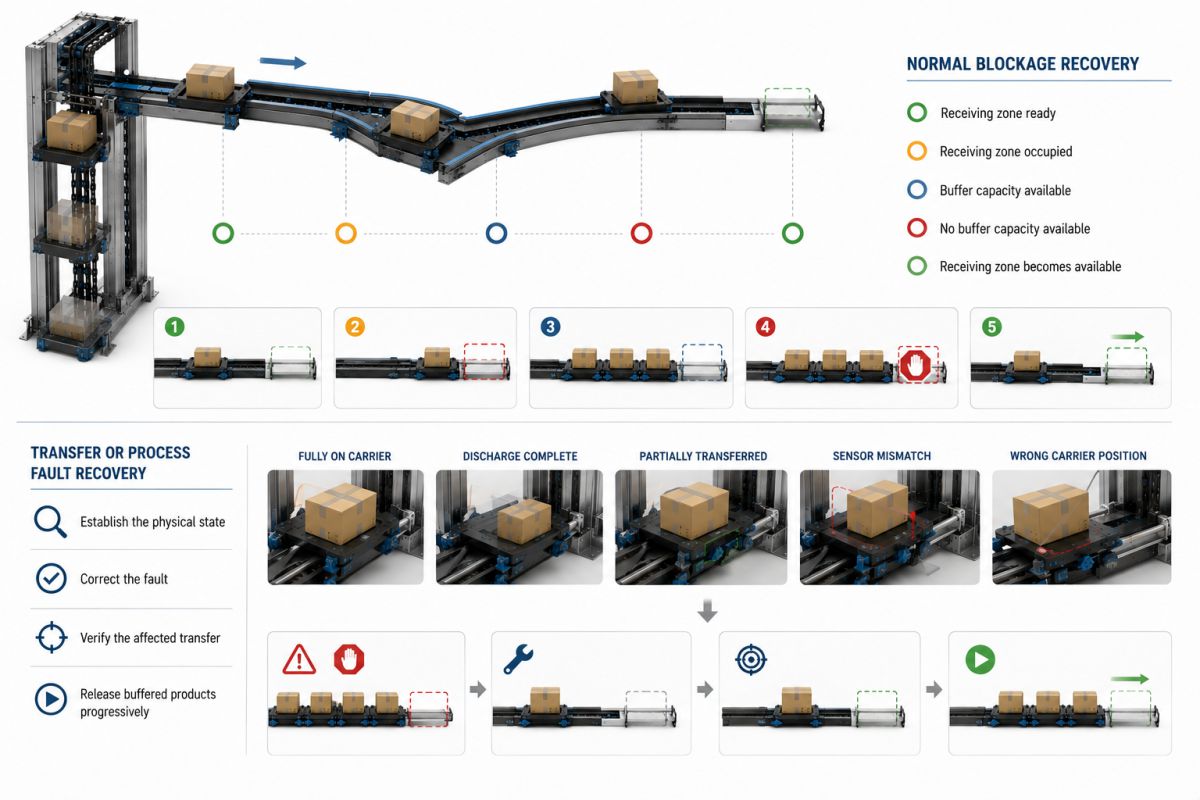
Normal Blockage Recovery
For normal downstream occupancy, keep the pending load in its approved hold position. Once downstream becomes available, reconfirm the receiving condition and complete the pending transfer before progressively releasing the upstream buffer.
Do not immediately restore full upstream flow. Buffer release should stay within the recovered downstream capacity.
Transfer or Process Fault Recovery
A transfer timeout, missing clear signal, carrier-position fault, conflicting sensor state, or physical jam needs a different recovery path.
Preserve the fault information and establish the physical state first:
- Is the product still fully on the carrier?
- Has discharge completed?
- Is the product partially transferred?
- Do the sensor states match the observed product position?
- Is the carrier at the expected transfer position?
A partially transferred or uncertain product state should not be treated as a normal occupied zone. Correct the fault, restore a known transfer state, verify the affected transfer, and only then release buffered products.
For recurring product or transfer faults, use the diagnostic sequence in the vertical conveyor jam causes guide rather than repeatedly extending timers or resetting alarms.
Safety-Stop Recovery
A safety stop is separate from process blockage. Resetting an emergency stop or guard function should restore the safety function to a restart-permitted state, not automatically resume conveyor movement. Safety restart, access, and hazardous-energy procedures must follow the machine safety design and site requirements.
Power loss deserves the same state-reconciliation principle. Retained PLC data should not be assumed to match the physical conveyor after power returns. Product occupancy, carrier position, transfer state, and downstream availability must be reconciled before automatic flow resumes.
A reliable restart continues from a confirmed material state—not simply from the point where motion stopped.
Good blockage control contains a downstream interruption before the interruption becomes a line-wide jam. Defined buffer positions, occupancy tracking, and upstream release control should keep every product in a known state while downstream is unavailable.
Restart from confirmed product, carrier, and receiving-zone conditions—not from a cleared alarm. When downstream capacity returns, release the buffer at the rate the receiving process can actually accept.
Send CS Conveyor your product rate, buffer layout, transfer sequence, and blockage conditions for a vertical conveyor control review.
Frequently Asked Questions
1. Is downstream blockage the same as a vertical conveyor jam?
No. Downstream blockage can simply mean the receiving zone is occupied and temporarily unavailable. A jam means the expected product movement or transfer sequence failed to complete. Both can stop outfeed, but the diagnosis and recovery logic are different.
2. Is a vertical conveyor itself an accumulation buffer?
Not automatically. A loaded carrier counts as buffer only when the machine design allows that position to hold, track, and later release the product safely. Empty carrier positions should not be treated as available buffer capacity by default.
3. How much upstream buffer does a vertical conveyor need?
Size the buffer by usable load positions and interruption coverage time, not conveyor length alone. Required capacity depends on incoming rate, existing occupancy, committed loads, expected blockage duration, product spacing, and downstream recovery rate.
4. Should the upstream conveyor stop immediately when downstream is blocked?
No, if verified buffer capacity remains. Controlled accumulation can continue until the remaining free positions are needed for loads already released upstream. New release should stop while enough capacity still remains to absorb those committed loads—not after the final buffer position is already occupied.
5. Should all buffered products restart at the same time?
No. Buffered loads should be released in a controlled sequence at the rate the recovered downstream process can accept. Uncontrolled release can immediately recreate the blockage or cause transfer conflicts.
6. Can a vertical conveyor restart automatically after a blockage?
Yes, normal downstream blockage can use automatic recovery when the required product, carrier, transfer-zone, and downstream states are confirmed. Transfer faults require a known material state to be restored first, while safety stops follow separate safety-recovery logic. A cleared downstream sensor alone is not enough to prove that the system is ready to restart.
Post time: Aug-18-2026


