

A vertical conveyor can handle several product sizes without changing carriers—but only if every approved SKU works inside the same carrier and transfer envelope. The largest product is not the only design case. A smaller carton may have the worst bottom support, another SKU may be the tallest, and another may place the center of gravity closest to the carrier edge.
The real design task is therefore to find the shared operating envelope: the support area, moving clearance, load position, transfer condition, and detection range that every approved product can satisfy.
This also separates multi-size capability from random mixed-SKU flow. A conveyor may handle several SKUs individually but still require recipe changes, guide adjustment, different spacing, or different transfer timing between products.
Minimum and maximum L × W × H define the size range. They do not define whether one carrier can handle the whole product mix.
Define the Mixed-Product Operating Mode
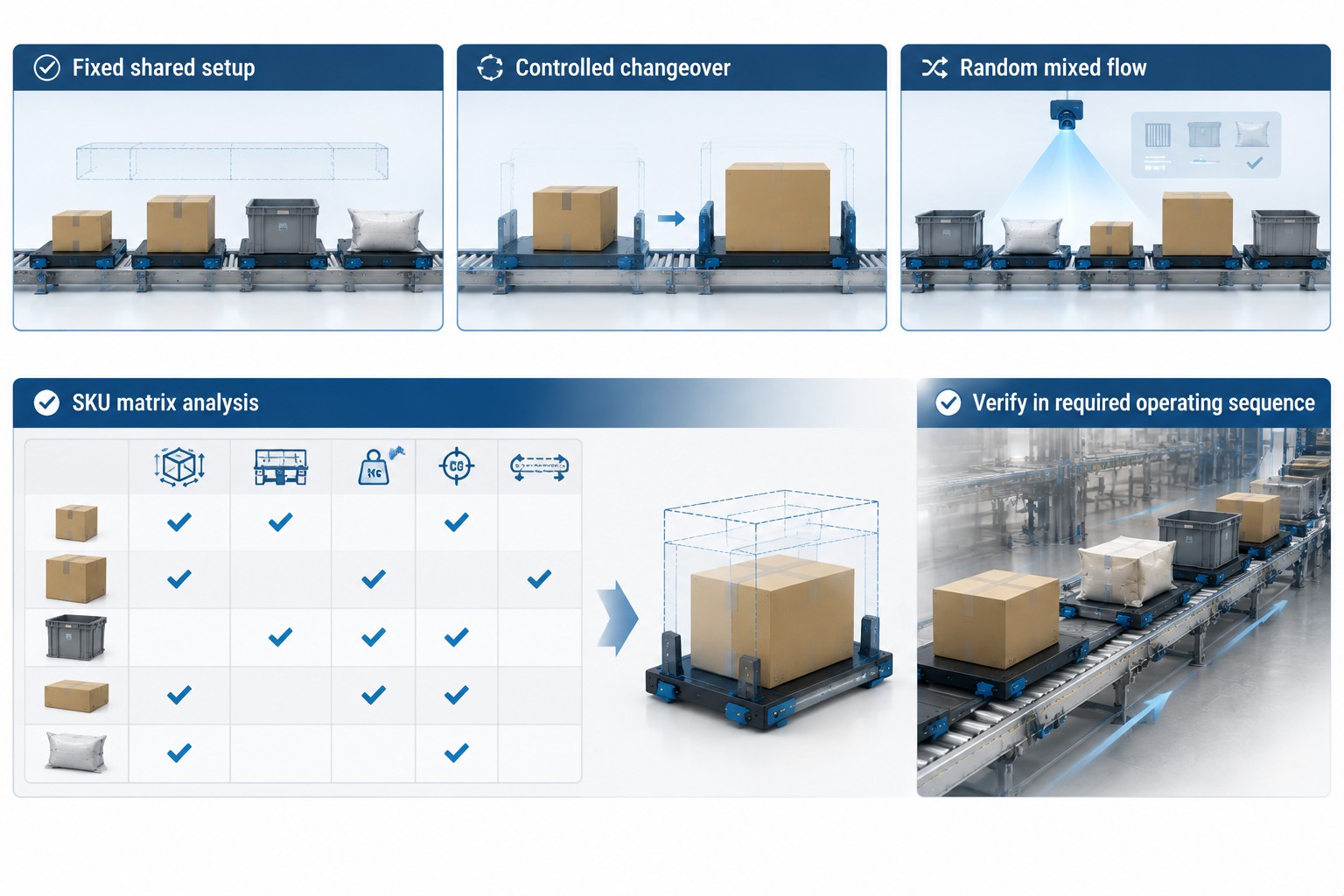
Handling several product sizes can mean three very different things. Before designing a shared carrier, define whether the conveyor must run all SKUs with one fixed setup, switch between product batches, or accept products in random order.
| Operating mode | Mechanical change | Control change | Random SKU order |
|---|---|---|---|
| Fixed shared setup | None | None or common settings | Yes, if every SKU shares the same operating envelope |
| Controlled changeover | Possible | Possible | No |
| Random mixed flow | None during production | Automatic SKU-dependent logic may be required | Yes |
A fixed shared setup is the simplest case. Every approved SKU uses the same carrier, guides, transfer position, sensor arrangement, and operating limits.
A controlled changeover still allows one conveyor to handle several products, but guide positions, stops, sensor settings, or control recipes must change between batches. The conveyor is multi-size capable, but not random-mix capable.
Random mixed flow is more demanding. Consecutive products must pass through the same mechanical interfaces without manual adjustment. If transfer timing, detection thresholds, destinations, or other operating conditions vary by SKU, the control system must identify the product and apply the correct logic automatically.
This is why a SKU matrix is more useful than one minimum/maximum size range. One product may define width clearance, another bottom support, another center of gravity, and another sensor or transfer limit.
Product sequence can also matter. Two SKUs may each run correctly alone but fail when placed back-to-back because the required carrier spacing, detection distance, or transfer timing is different.
A shared carrier is not proven when every SKU works individually. A mixed-product system is proven when the approved SKUs also work in the required operating sequence.
Define the Shared Carrier Envelope
A shared carrier is not designed around one largest product. The carrier must combine the largest required clearance with the common support and stability conditions that every approved SKU can accept.
Different SKUs can therefore control different parts of the design.
| Design limit | Limiting condition | Carrier requirement |
|---|---|---|
| Support | Smallest usable bottom area, runners, ribs, feet, or openings | Common support points must work for every SKU |
| Width / height | Widest and tallest approved SKUs | Moving envelope must clear the frame, guides, and adjacent carriers |
| Load | Highest weight and worst load distribution | Carrier structure remains within design limits |
| Stability | Highest or most offset center of gravity | Load remains stable inside the effective support area |
| Orientation | Every permitted product direction | Support and transfer geometry remain compatible |
The most important check is the common support zone. A large flat-bottom carton may be easy to support, while a smaller tote with ribs or recessed feet may leave very little usable contact area. A shared fork or platform arrangement must therefore match the overlap in usable support geometry across the complete SKU range.
Clearance works differently. Maximum width, height, overhang, and carrier geometry define the required moving envelope, including the straight lift path, return sections, and transfer openings. The SKU that controls width does not need to be the SKU that controls height.
Stability adds another limit. Check the worst approved center-of-gravity position, offset loading, product overhang, and any internal load movement. The heaviest product may control carrier strength, while a taller or lighter product may create the more difficult stability condition.
Product orientation must also be fixed. Rotating a tote or pallet can move runners, ribs, openings, and the center of gravity relative to the carrier. Any orientation that falls outside the shared envelope should be prevented before the product reaches the lift.
Fork, platform, support-point, and moving-envelope design are covered in more detail in the vertical conveyor carrier design guide.
A shared carrier works only where the acceptable support, stability, transfer, and clearance conditions of all approved SKUs overlap.
Fixed Geometry vs. SKU-Dependent Settings
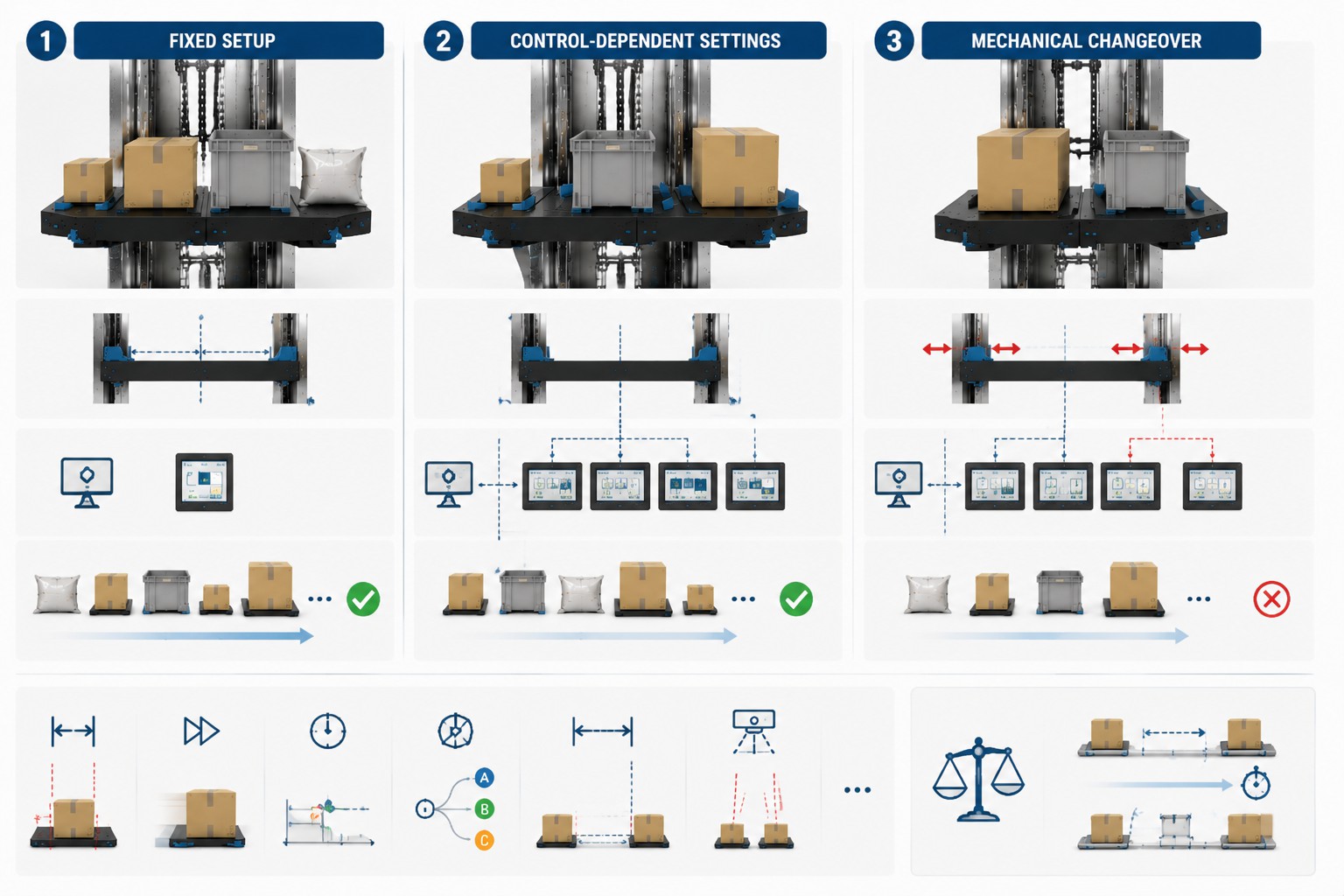
One shared carrier does not mean one shared operating setup. Mixed product sizes may use the same carrier while guides, stop positions, sensing, transfer timing, or control settings still vary by SKU.
The required changes usually fall into three levels:
| Change level | Mechanical setup | Control settings | Random mixed-SKU flow |
|---|---|---|---|
| Fixed setup | No change | Common settings | Yes |
| Control-dependent | Fixed | SKU-specific settings | Yes, with automatic SKU identification |
| Mechanical changeover | Manual or automatic adjustment required | May also change | Manual adjustment normally limits random sequencing |
A fixed setup is the simplest case. The smallest and largest products must share the same guide positions, transfer geometry, sensing coverage, and carrier support.
When mechanical geometry can remain fixed, SKU-dependent control can handle differences in stop position, transfer speed, timing window, destination, or metering logic. SKU identification must therefore occur early enough for the correct settings to be active before the product reaches the transfer point.
Mechanical adjustment is required when one guide width, stop position, restraint, or centering geometry cannot accept the complete product range. Manual adjustment makes the conveyor suitable for batch changeover, but normally prevents unrestricted random mixed-SKU flow.
Carrier pitch usually remains a fixed mechanical parameter. Smaller products do not create closer carrier positions; product mix instead changes carrier utilization, metering distance, transfer time, and usable capacity. Those effects should be checked with the vertical conveyor capacity calculation.
Mechanical changeover is the dividing line between batch flexibility and true random mixed-SKU flow.
Validate the Shared Carrier Across the Full Product Mix
A shared carrier is not proven by running only the smallest and largest products. Validation must cover the limiting SKU for each design condition and, for random mixed flow, the transitions between those SKUs.
| Validation condition | Limiting SKU or case | Required result |
|---|---|---|
| Support | Smallest usable support area or worst bottom geometry | Stable support through loading, travel, and discharge |
| Width / height | Widest and tallest SKUs | Full moving-envelope clearance |
| Load | Heaviest or worst-distributed load | Carrier remains within the approved load condition |
| Stability | Highest or most offset center of gravity | No unacceptable sliding, rotation, or tipping |
| Orientation | Every permitted orientation | Support and transfer remain compatible |
| Changeover | Every required setup or recipe | Correct settings are repeatable |
| Mixed sequence | Consecutive limiting SKUs | Correct mechanical and control state for every transition |
The limiting conditions will rarely belong to one product. One SKU may define carrier width, another bottom support, another structural load, and another stability or sensing requirements. A complete SKU matrix should therefore record product dimensions, weight, bottom geometry, support points, orientation, load distribution, transfer condition, and any required SKU-dependent setting.
For batch operation, verify each approved product family under the required setup. For random mixed-SKU flow, also verify boundary-to-boundary transitions: large to small, tall to short, light to heavy, different orientations, and consecutive products that create the most difficult transfer or control sequence.
Define the acceptance criteria before testing. Each approved condition should maintain:
- Stable carrier support
- Required moving clearance
- Correct guide and control state
- Reliable product detection
- Complete infeed and discharge transfer
- Repeatable operation without SKU-specific intervention
The shared-carrier concept should be reconsidered when the approved products have no practical common support zone, incompatible transfer geometry, unavoidable mechanical changeover during random flow, or a moving envelope that forces carrier spacing below the required capacity.
One carrier fits the full product mix only when both the limiting SKUs and the required SKU transitions work inside the same verified operating envelope.
A shared carrier works only when every approved SKU can remain inside the same verified support, clearance, transfer, and control envelope. The largest product does not define that envelope alone; different SKUs may control different design limits.
For random mixed flow, the carrier must also handle the required SKU-to-SKU transitions without manual mechanical changeover. If no practical common operating envelope exists, forcing one carrier across the full product mix usually creates more transfer and control problems than it solves.
Send CS Conveyor your SKU list, product dimensions and weights, bottom photos or drawings, required throughput, and mixed-flow requirement for a shared-carrier design review.
Frequently Asked Questions
1. Can different product sizes run through the same vertical conveyor in random order?
Yes, if the complete SKU range shares the same mechanical envelope or the required SKU-dependent changes happen automatically. If guides, stops, or transfer hardware need manual adjustment between products, the system is batch/changeover capable rather than true random mixed flow.
2. Do mixed products need the same bottom geometry?
No. Different bottom shapes can use one carrier if every SKU still has a compatible support area. Check ribs, feet, runners, openings, flexible sections, and actual contact points; similar L × W dimensions do not guarantee the same support condition.
3. Can products with different weights use the same carrier?
Yes, if carrier structure, support, and transfer remain acceptable across the full weight range. Check load distribution and center of gravity as well as maximum weight. The heaviest SKU is not always the most difficult product to handle.
4. Does one shared carrier mean no product changeover is required?
No. One carrier can remain fixed while guides, stop positions, sensor settings, transfer timing, or control recipes still cnge by SKU. A true no-changeover system requires every approved product to run through the required sequence without manual mechanical adjustment.
5. Does the largest product determine vertical conveyor capacity?
No. The largest or tallest SKU may determine carrier spacing and moving clearance, but usable capacity also depends on carrier arrival frequency, products per carrier, transfer time, product mix, and upstream and downstream flow. A different SKU may create the actual throughput limit.
6. When is one shared carrier no longer practical?
Reconsider one shared carrier when the approved SKUs have no practical common support zone, require incompatible transfer geometry, need manual changeover during random flow, or force carrier spacing that cannot meet the required throughput. In those cases, separate carrier designs or product families may provide a simpler and more reliable solution.
Post time: Aug-17-2026


