

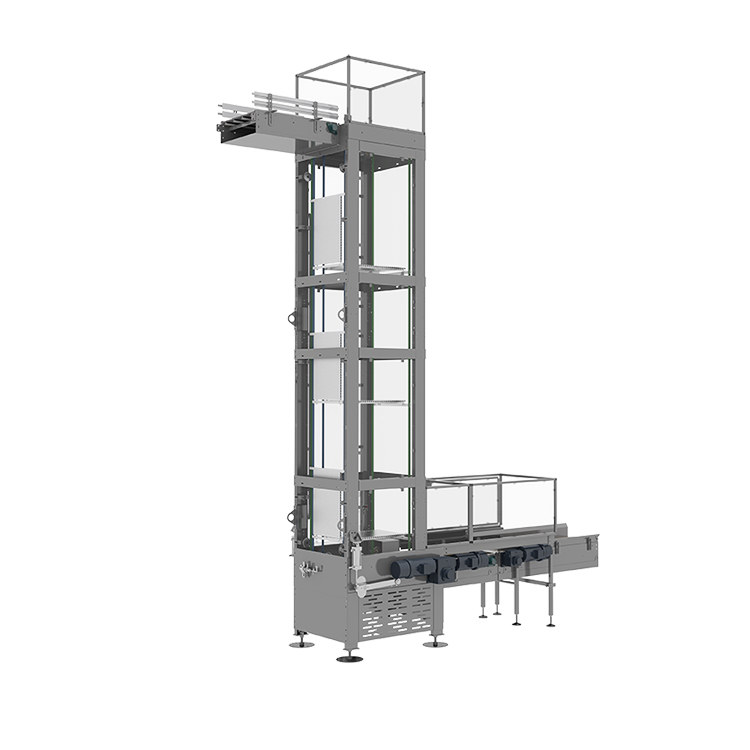
An elevator conveyor moves products or bulk materials between different elevations as part of a material-handling system. Terms such as elevator conveyor, conveyor elevator, and elevating conveyor are often used broadly, but they can describe very different machines. A bucket elevator may lift grain or powder in a continuous series of buckets, while a reciprocating lift moves cartons or pallets on one carriage, and a continuous vertical conveyor circulates multiple carriers between levels.
The right system therefore depends on what is being moved, the required throughput, lift height, transfer arrangement, available footprint, and operating environment. Choosing by lift height or equipment name alone can lead to the wrong conveyor architecture.
What Is an Elevator Conveyor?
An elevator conveyor is conveyor equipment whose primary function is to raise or lower material between different elevations.
The first selection boundary is the load:
- Bulk materials such as grain, powders, pellets, and granules require containment and controlled filling and discharge.
- Unit loads such as cartons, totes, trays, bags, and pallets require stable support and repeatable infeed and outfeed transfers.
Because these loads behave differently, the term elevator conveyor can describe several substantially different machine types.
What Are the Main Types of Elevator Conveyors?
Bucket Elevator Conveyor
A bucket elevator conveyor uses a continuous series of buckets to lift flowable bulk materials such as grain, pellets, powders, and granules.
Selection depends on bucket volume and spacing, material properties, operating speed, loading and discharge method, abrasion, moisture, sanitation, and cleaning requirements.
Elevating Belt Conveyor
An elevating conveyor moves products continuously along an incline. Cleats, flights, or sidewalls may be added when the incline is too steep for a flat belt to maintain product position.
This is often a simple solution when the product remains stable on an incline and enough horizontal space is available. Its main limitation is that greater elevation normally requires additional conveyor length.
Reciprocating Lift Conveyor
A reciprocating lift conveyor moves one carriage or platform between fixed elevations.
It is suitable for cartons, totes, pallets, and heavier unit loads. Throughput depends on the complete cycle—including loading, vertical travel, positioning, unloading, and the required return movement—not vertical speed alone.
Continuous Vertical Conveyor
A continuous vertical conveyor circulates multiple carriers through a closed vertical path, creating repeated loading and discharge opportunities.
It is suited to regular flows of cartons, totes, trays, and similar unit loads. Usable capacity depends on carrier pitch, travel speed, transfer time, product stability, and downstream availability.
| Type | Best suited to | Main advantage | Main limitation |
|---|---|---|---|
| Bucket elevator | Bulk materials | Compact bulk lifting | Depends strongly on material properties |
| Elevating belt conveyor | Stable products | Simple continuous flow | Requires incline length |
| Reciprocating lift | Cartons, totes, pallets | Flexible load handling | Cycle-based throughput |
| Continuous vertical conveyor | Repeated unit loads | Frequent transfer opportunities | Requires coordinated transfers |
What Are the Advantages of an Elevator Conveyor System?
An elevator conveyor system uses vertical space as part of the production flow. This can connect machines at different heights, move products between floors, route material to mezzanine conveyors, or carry products above other production areas.
It can also integrate directly with upstream and downstream conveyors. Sensors, transfers, accumulation, and PLC controls allow the elevation change to become part of the automated production sequence rather than a separate manual handling step.
Another advantage is architecture flexibility. Bulk materials can use buckets, stable products can use inclined conveyors, heavier loads can use reciprocating platforms, and frequent unit-load flow can use continuous carriers.
The benefit therefore comes from matching the lifting principle to the actual product and process.
What Is the Difference Between a Conveyor and an Elevator?
A conveyor is the broader category. It moves material along a defined horizontal, inclined, curved, or vertical path.
An elevator specifically emphasizes the change in elevation.
In industrial material handling, an elevator conveyor or conveyor elevator generally refers to conveyor equipment whose main purpose is to raise or lower material as part of a production or logistics process.
The more useful engineering distinction is therefore not the equipment name, but how the product is supported, moved vertically, and transferred to the next process .
How Do You Choose the Right Elevator Conveyor?
Start with the product and required material flow.
| Selection factor | What to confirm |
|---|---|
| Product | Bulk material or unit load |
| Load data | Size, weight, base, bulk density, flowability or stability |
| Vertical travel | Infeed and discharge elevations |
| Throughput | Products/hour, loads/hour or bulk flow rate |
| Transfers | Infeed, outfeed, direction and number of levels |
| Layout | Available vertical and horizontal space |
| Environment | Dust, washdown, corrosion, temperature |
| Maintenance | Cleaning, wear parts and service access |
For bulk materials, properties such as density, particle size, moisture, flowability, and abrasion strongly influence bucket-elevator design.
For unit loads, verify that the belt, carrier, or platform supports the complete approved product range and that loading, vertical movement, and discharge can all meet the required sustained throughput.
The term elevator conveyor covers several methods of moving material between elevations. Bucket elevators suit many bulk materials, while elevating belt conveyors, reciprocating lifts, and continuous vertical conveyors address different unit-load, throughput, and layout requirements.
Start with the product, required throughput, lift height, transfer arrangement, and available footprint. The right elevator conveyor is not simply the machine that reaches the required height—it is the system that moves the approved load through the complete material-flow cycle reliably.
Post time: Sep-06-2023