

What is a flexible chain conveyor?
A flexible chain conveyor is a modular conveyor system that uses a side-flexing plastic chain to move products through straight sections, horizontal curves, inclines, declines, and elevation changes. The chain runs inside an aluminum or stainless steel conveyor beam and can carry products directly or support pallets and fixtures.
Flexible chain conveyors are especially useful where one conveying route must connect several process stations within limited floor space. The system should be selected from the product, conveyor path, load, speed, curves, guides, transfers, and operating environment rather than chain width alone.
What Is a Flexible Chain Conveyor and How Does It Work?
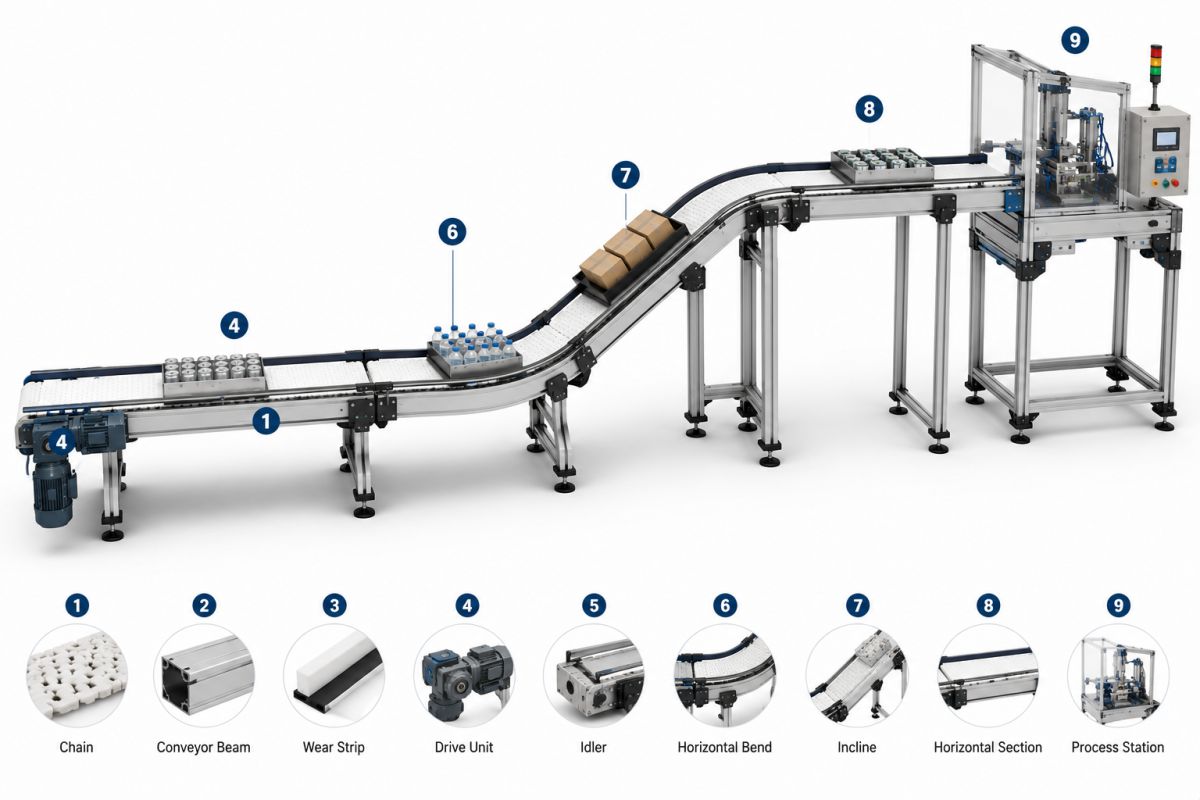
A flexible chain conveyor system consists of more than the chain itself. The complete system normally includes the flexible conveyor chain, conveyor beam, wear strips, drive unit, idler end, horizontal and vertical bends, guide rails, supports, and controls .
The drive unit pulls the chain along low-friction wear strips inside the beam. Side-flexing chain articulation allows the conveyor to follow horizontal curves, while vertical bend sections allow the conveying path to rise or descend. Guide rails keep the product controlled as the conveyor changes direction.
Products can travel directly on the chain surface or on pallets and fixtures. Different chain surfaces can also be selected for accumulation, increased friction, delicate products, or application-specific handling requirements.

Where Does a Flexible Chain Conveyor Work Best?
Flexible chain conveyors work best where the material-flow route must combine straight sections, curves, and elevation changes without using a separate conveyor at every change of direction. Their modular construction is particularly useful in compact production layouts.
Typical conveyed products include bottles, cans, cartons, trays, small components, and palletized parts. Depending on chain surface and guide design, the system can support transport, accumulation, positioning, merging, diverging, and controlled incline or decline movement.
Electronics and automation applications are also well suited to flexible chain conveyors when small components, trays, battery parts, or assembly pallets must pass through several process stations in a compact line. Product support, anti-static requirements, guide rails, pallet design, and transfer accuracy should be verified for the actual application.
Flexible slat chain conveyors are also widely used in food and beverage, pharmaceutical, cosmetics, packaging, and general industrial automation.
How Do You Select a Flexible Chain Conveyor System?
| Selection factor | What to check |
|---|---|
| Product | Size, weight, base and center of gravity |
| Chain width | Sufficient support for the product |
| Conveyor path | Straight sections, curves, inclines and declines |
| Curve geometry | Minimum usable radius for the selected chain |
| Speed and load | Chain pull, drive capacity and accumulation |
| Guide rails | Product stability through curves and transfers |
| Chain surface | Standard, high-friction, roller, anti-static or special surface |
| Environment | Washdown, dust, corrosion and temperature |
| Transfers | Infeed/outfeed support and product handoff |
Design the conveyor route before finalizing the chain and drive. Every horizontal curve and elevation change adds friction and chain pull, so a configuration that works on a short straight conveyor may require a different drive arrangement when the route becomes longer or more complex.
Product support must also be checked through curves and transfers. A chain that is wide enough on a straight section may still require different guide rails, pallet support, or transfer geometry to keep the load stable through the complete conveying route.
A flexible chain conveyor should not be confused with the side-flexing chain itself . The chain is one component of the conveyor system; the complete machine also includes the beam, wear strips, bends, drive, guides, supports, and transfers.
A flexible chain conveyor is most suitable when one material-flow route must combine straight runs, horizontal curves, and elevation changes within limited space. Its modular construction makes it useful for compact automation, packaging, electronics, food, pharmaceutical, and general production lines.
Final selection should be based on the product, conveyor route, chain width, curve radius, speed, load, guides, transfers, and operating environment. Verify the complete route before finalizing the chain, drive, and beam configuration.
Related products
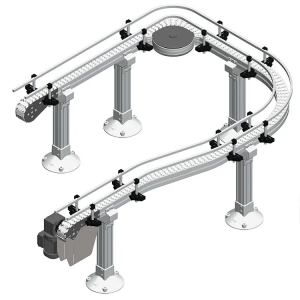
Plastic Flexible Chain Conveyor System
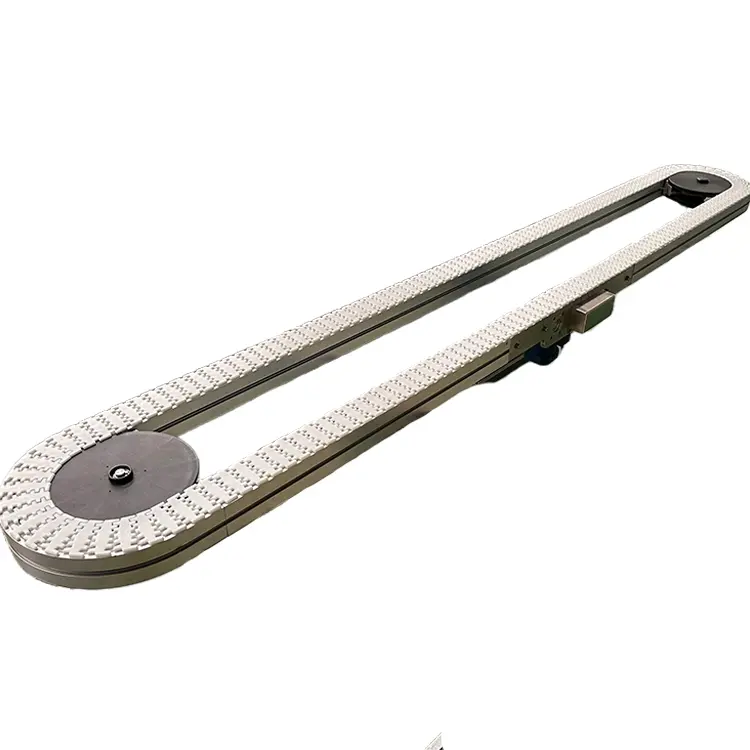
Factory Customization High Quality Flexible Chain Plate Conveyor
Post time: Sep-21-2023